WYSIWYG

What You See Is What You Get. This is a journal blog, an explore-blog, a bit of this and that blog. Sharing where the mood takes me. Perhaps it will take you too.
Showing posts with label Advaita Vedanta Concepts. Show all posts

MenoSundays; Life Lived Lovingly

Over the last three Sundays, we have seen a little of what Advaitic philosophy tells us about karma. The law of cause and effect with respect to our individual life experiences. 

Many of us would like it to be as simple as tit-for-tat. As we've read, though, as with all physics and quantum theories, the simplicity is complicated by so many factors. As with physics and quantum, we can come to deeper understandings as long as we are prepared to put the work into absorbing the necessary strands of learning. For some, this work is thrilling and uplifting. For others, it is a matter of pride and competition. Then, others just can't be bothered with the effort, as there are far too many distractions in life. 

By now, it is hoped, you will recognise the sattvic, rajasic and tamasic responses!

A question may arise as to what is right or wrong about any of these reactions. Advaita doesn't make a judgement on this. We are what our makeup of praarabdha and purushartha (established pattern and efforts to change it) result in us being and what we might become.

That said, no matter which society we are born into and how much difference there may be between all those societies (cultures), in every place, there is a sliding scale as to what is acceptable behaviour and what is reprehensible. This brings us to the question of good versus evil. It raises the spectre of individual responsibility versus the common good. Also, when we dig into it, we find that all societies have a similar idea of what constitutes 'good living' versus ' wrong living'. The world over, we all want to live without hassle, in peace and safety.

Scientifically, we know that everything we perceive is matter. Matter comprises all sorts of building blocks, which, for this post, we shall refer to as tanmatras**. Socially, we know that communities are made up of many individuals. Just as matter can only form shapes/things by the tanmatras forming solid bonds that hold any given item together, so it is that communities can only remain stable for as long as the individuals within it form the appropriate bonds of kinship. All things of matter will erode: the length of time depends upon many things, not least how well the bonds were formed in the first place and what the environment around them is like. The tanmatras will often be taken up and reformed into new items. All individuals within a community will erode according to their health and environment. All humans, it is to be remembered, are made up of matter only. All communities eventually erode, often to be replaced with reformed ones.

A key difference between humankind and all other matter is that our central nervous system has evolved to such a degree that we debate what is good and what is not. Other sentient species on our planet do have social bonds and appear to have determination as to status within their societies, but only the human critter has formed philosophy and advanced strata of laws and statutes to guide the mass of individuals along a communal path of decency.

Every society, then, forms its own philosophy of right and wrong. The basis of all such philosophies is to achieve the betterment of those groups by encouraging the self-improvement of the individuals within the group. 

The human critter has the incredible ability to correct itself.

We are blessed with the antaH-karana**, the four-fold processing unit most commonly referred to as the mind. Again, one word loses the subtle complexity!

Back then, to our individual karma—our tale of action. What needs to be understood is that action is the result of a process that begins with the seed of a desire in the individual. From desire arises thought, first of the 'I want...' variety and then quickly supplanted by the 'do this or that to get it' thoughts. Then, action arises. What action we take must result in a corresponding reaction in the jiva's timeline - it might be immediate, such as indigestion due to overindulgence as we satisfy our food desires, or very long-term. Neither should we think that karma means 'bad things happen to bad people.' There is positive karma also - and none of us is free from it. Simple physics. Cause will always have effect.

It is important to understand that the matter of which we are made is totally neutral. The physics/quantum nature of our existence has nothing to do with the quality of any action. The goodness or badness of anything is a concept held only within the intellect. By becoming so aware of our existence, we have also had to contend with the consequences of that awareness. It is the very essence of what makes us 'human'.

The next point to understand is that this is not a static thing. Our concepts of what is right and wrong have mutated over the centuries. Actions that were once celebrated—like the persecution of religious minorities or the subjugation of other races—are now widely recognized as evil. This didn't happen because the physical world's moral character changed but because human society evolved in its understanding. We can, through a study of history, also recognise there is a cyclical nature to such behaviours. Whilst societies may learn and seek to move the human race along a better path of community collaboration and peace, it will only hold for as long as the balance of individuals within it opts to follow that path.

This brings us to the wider karmic cycle. Communities will always reflect the majority tendency of the individuals within them, which is when we start to see cliques. This is why we get 'desirable residence' areas versus those that are feared or jeered. 


As individuals, we have to determine how we wish to behave in the world. Are we prepared to stretch ourselves and seek to live life lovingly, no matter how strong the tide is currently against that? Can we fund the moral fibre within ourselves to spread capital 'ell' Love by being the example - not by preaching, thumping, threatening, but by accepting that there are many streams feeding into the river of Love and letting it flow? 

**Tanmatras, antaH-karana... the first is the name given to the elements in Advaita - which looks at the physics of creation as much as the metaphysical; the second is the exploration of what makes the human psyche. If you have found this month's series of posts interesting - would you like posts on these also? Thank you to all who have read and responded.

MenoSundays; Life Lived Lovingly


Continuing this little series of posts on the Law of Karma. This one is a sort of summary (summation?) of the first two posts...

Gati - results (hereafter)

Every action has an equal and opposite reaction... 'as we sow, so we reap.'  The results of mental, verbal, or physical actions are;
a)  the joy or sorrow that we experience while doing the action
b)  the impression, good or bad, which it leaves within us (vaasana)
c)  the outer results we get in terms of circumstances, which fructify in their own time. Some results of action are immediate, whilst others may not come till some time later, such as weeks, months, or years. Still, others may take lifetimes to be exacted upon us.

During our lifetime, we enjoy or suffer the consequences of all actions done in our past, be it within this life or any of our past lives. All actions create vaasanas in our minds. At the time of death, the predominant vaasanas from this and earlier lives are drawn together to determine the quality and 'texture' of future incarnations; the vaasanas also determine the type of body and the field of experience we shall obtain hereafter.

Sattvic; at the time of death, a predominantly sattvic mind goes on to gain the highly subtle body of a presiding deity and enjoys subtle fields of experience... or he may be born as a human being and enjoy a high standard of living or gain a sattvic environment in which to fulfil the sattvic vaasanas brought into life.

Rajasic; a predominantly rajasic mind at the time of death, manifests as a human being in an action-oriented environment where he can exhaust his vaasanas of indulgence and activity.

Tamasic; a person with predominantly tamasic vaasanas at the time of death, manifests as a human being in an inert or poor environment or as some form of animal or plant; there, he can exhaust his vaasanas of inertia and live in a state of non-thinking.

From this, you would think living a sattvic life seems common sense, would you not? However, you will gather that even the best intentions can go awry if we are not watchful of the vaasanas within us - those grooves of experience that mark us, however subtly. It is also one of the anomalies of life that we very often identify the grooves in others but are less able to see those within ourselves. Very often, it is only when we are faced with our mortality that we properly begin to assess ourselves. Either that, or we continue in total denial of who we truly are! 

Indeed, how you receive the knowledge within this karmic concept will come down to where you lie in the spectrum of saatva, rajas, or tamas. It will be immediately understood, or taken on board, challenged and tested... or totally rejected... This is not a judgment but a statement of fact. We are who we are but we can be something more. Even the best of us can always find something within us to improve. This is the kernel of living life lovingly.


MenoSundays; Life Lived Lovingly


Thank you for responding to last week's intro to exploring The Law of Karma. This is such a vast subject, not one that stands solo. Whilst these posts arise from the teachings of Advaita Vedanta, there is a universality (secularism) to the principles that can be recognised, regardless of one's background or philosophical leanings. It is a challenge to "nutshell" the concepts, and questions and doubts will certainly be raised - and that is fine! Advaita welcomes the questioning mind, the searching spirit, and the doubting intellect. 

In many respects, it is as simple as 'what goes around comes around'. Accepting that action executed, every decision taken, must undergo its consequences, whether expected or not, is a little more complicated.  Firstly, we have to absorb the concept of vaasanas - the impression left by experiences. These are the 'programming' of our individuality. As long as we work on our vaasana instructions, we will be caught up in desires, agitations, and the actions resulting from seeking to quell them. The actions will 'imprint' according to the result obtained, which leads to affirming existing vaasanas or creating new ones that will bring on further action.


It is the law of cause and effect that governs karma. Let us look a little closer. Each person is who they are based upon the yield of past actions. From birth through to the end of life, if actions are of noble and pure intent, that person might be said to be one of dignity or goodness. Equally, we see others who live with viciousness and immorality, and we mark these as 'bad eggs'. Everyone has a concept of what is acceptable behaviour and what is not. What drives this is not only the circumstances around them (which can be seen and easily 'accused') but also the very nature of each individual, the personality with which they are born. Hence, we can find 'bad eggs' arising from otherwise agreeable roots, and conversely, we see giants of virtue coming out of the worst of circumstances.

Thus, we can conclude that what drives a person's life is not so much the environment but how they respond to it - and this is ascribed to karma. We can look at this and say, 'Well, that was their destiny,' and leave it at that. How lacking in curiosity would that make us?!

Karma is not simply destiny (which has the sense of being written in stone, and therefore, nothing can be done about it). It is much more dynamic than this. To fully understand karma is essential in Vedanta, for it clarifies how we even have come to be reading the philosophy itself. The 'destiny' part of karmic law is that which is called praarabdha. It is the 'effect' of the causative past in current life and all previous existences. It can be seen that balance has to be brought to bear, deeds answered for, and to this extent, we must live out destiny. However, along the way, each jiva (the individualised soul) has the capacity to climb the spiritual ladder, cancelling out the karmic account and developing ever greater strength to correct the course of praarabdha.  This self-effort is called purushaartha (wealth of cosmic man), and this is the seed of the phrase "Lord helps those who help themselves". Thus, it can be said that the present praarabdha is a result of past purushaartha. Equally, every action from this moment of understanding can have purushaartha behind it to ensure an improved praarabdha as we go forward, leading to final liberation (moksha) from the whole cycle.

In short, what one meets in life is praarabdha, and how one meets it is purushaartha.

We have the power of our future within ourselves. Through our purushaartha, we can really make a difference in our soul's journey. Whether we choose between preyas (path of ease) or shreyas (path of good) may be written at birth according to praarabdha, but if we have earned enough karmic points, we will come to understand that choices can be made to change or improve our paths. We cannot completely wipe praarabdha's slate, but it can be said that the future is a continuity of the past, modified with purushartha in the present.

Now, the mix gets a little more complex. Yes, we have freedom of choice between positive and negative actions in terms of our purushaartha; however, those choices are still largely coloured by the depth of our praarabdha.  Gurudev, Swami Chinmayananda, gave an excellent example of a boat on a river. Without an engine (no choice), it must only flow as the river flows; if we add an engine (purushaartha), we can certainly give the boat independence of the river...but for as long as it remains on the river, despite being more steerable, it is still to some extent governed by the current already in place; thus if going down river the boat is actually going faster than its engine is driving it, but if it is going upriver, it may be battling to maintain speed.  This explains how, even when we have a good and well-planned life, we can hit heavy 'back-currents', and we wonder what we did to deserve the strife!  We may never know the source of the eddy or the whirlpool. All we can do is seek to regain balance through purushaartha, titiksha, shraddha and so on.

We are, then, a product of our past but can be producers for the future. Praarabdha (law of destiny) applies only to past actions and makes us victims. However, Karma (law of consequential action) ensures the ability to create and quell praarabdha. The logic behind this is well seen in present life with things such as education (the more effort put the better the qualification) and such like; what can take a little more to absorb is that there are many, many, many lives which contributed to praarabdha and there may be many more to endure until purushaartha can yield the most favourable result of all - the balancing of our karmic debt and we can sign off the cosmic account.

Yes, I am aware that you are also being introduced to the concept of reincarnation here. However, even in accepting this is the one and only existence we have, does it not make the urgency of positive living, living life lovingly, all the more imperative? Even if we have only these most fleeting "three score and twenty" to display our light of consciousness, is it not better to ensure our actions speak positively for us?


MenoSundays; Life Lived Lovingly


Recently, some very interesting comments were made on the "karma as action" quote. Karma is one of those words that has been adopted into English and somewhat mutated. 

Not entirely: it is true that karma reflects how we have lived our lives, so contained within that is the idea of getting a comeback on behaving badly. It is, though, way more complex than this, so this month, I am going to focus on providing you with a more detailed understanding of karma and how we all live it, regardless of our philosophical base. 

Action is the insignia of life. Man cannot live without actions. Actions by themselves are neither good nor bad. It is the intentions behind them which make them such. For example, when a doctor performs surgery, it is not called assault with grievous bodily harm, even though sharp implements are used, and the body is slit open. It is being done to improve health.  All undertakings in life may be categorised per the triguna (three qualities), depending upon the intentions behind them.

Sattvic; proper and deep thought behind an action makes it a sattvic undertaking. One thinks about the goal that engenders the action and the consequences and/or results that may ensue. One also thinks about the time, effort, cost and so on. Sattvic thinking enables strong prioritising and setting of clear goals. There is also a consideration of the effects on others when carrying out the action or what might arise from it. There is a strong assessment as to whether any given action is a worthy one or, indeed, worthwhile (i.e., is it sufficiently noble or even worth our investment of time, etc.). "Plan out your work, and then work out your plan!" After planning well, when all one's energies are focused on one's actions, it is more likely to be efficient and successful. What is more, if variations and hurdles arise, one is better equipped to deal with them - as our planning ought to contain 'contingency'. The benefits of sattvic action are often sustainable and long-lasting.

Rajasic; incomplete and distracted thinking makes an undertaking rajasic. Actions based on immature or hurried thinking, half-baked plans or overly sentimental promptings often fall short in terms of purpose and fulfilment. Having too many goals (multitasking) is likely to result in a lesser standard of completion...the term 'jack of all trades and master of none' was made for such as this! Improper thinking, procrastination, disorganisation, and stress… all arise in rajasic action. Undoubtedly, things will get done, but often without appropriate satisfaction, and the benefits will likely be short-term.

Tamasic; rash, whimsical, indiscriminate, impulsive...these are words often associated with tamasic action. The term 'act in haste and repent at leisure' would apply here. Often, tamasic action is driven almost purely by strong emotion, logic having left the building! There is rarely any positive result for such a situation.  There may be immediate gratification, but this is followed by more immediate need, and cycles of guilt, regret, and misery are created.

The aim of life is to always live in the space of sattvic. However, we are all flawed to a degree and thus will all experience some rajasic or tamasic times. Striving for the best is something we can all do. Embrace capital 'ell' Love! 


MenoSundays; Life Lived Lovingly


It is a peculiarity of the human race that there is a need deep within to have something higher to look towards for succour, guidance... absolution... As society developed, so did many and varied ways of worship. Reverence, however, is often misguided. Remember, ultimately, we are our own best source. We can come to know this source best through proper devotion; that is to say, with full vision of what it is we wish to attain, with clarity of thinking, keeping only that which drives us towards that attainment, and dropping all other distractions.

The terms for these in Sanskrit are viveka - discrimination, and vairaagya - dispassion. Viveka and vairaagya are the two wings to help us soar above our baser nature and reach toward that which we worship. To become the best that we can be.


MenoSundays; Life Lived Lovingly


Read it carefully. Think on the statement, 'Man has created God in his own image.'  The Great Rsis of Sanskrit antiquity and all mahatmas who have followed Jnana-yoga since have come to understand that we are our own power... our own deity. Humankind alone is responsible for being human, and that, too, the very best human that it is possible to be. Yet Humankind remains, at the physical level, nothing more than any other living creature - an animal; flesh and blood, nature, raw in tooth and nail. Worse. For that very consciousness that enables the flights of intellectual brilliance, when mixed with the ego, the lust, the greed for things of the world, so often leads us into the realms of avarice, jealousy, then down the paths of manipulation, theft, causing harms... raising wars.

Each of us can only be responsible for ourselves. In doing so, we set examples that others might, in their turn, rise.


Menorkulturable; Imbibing Art And Philosophy

Before I begin, just dropping in a reminder that next week is the final Final Friday Fiction slot for the year! Also, the 2023 badge will be revealed, and the update to the concept. Now, are you sitting comfortably?

Regular readers will have noted hints at my having been sniffing out interesting things to inspire posts and build narratives. As we plummet down toward 2023, here is a taster of the sort of thing that has been catching my attention. It is more recent than some items on my bookmark shelf, but a more stand-alone item and fitting for a pre-Christmas view/read. 

On Sunday, past, I read an interview with the actor Mark Bonnar. I have followed his career for some years now. He's one of those faces and talents who impresses wherever he appears but is somehow always secondary to the main protagonist of the piece he is in. An actor's actor. At the very least, all of you who have watched the detective drama Shetland will be familiar with him as the slightly dodgy Duncan, a friend of Perez and step-dad to his daughter. Okay, that was fine in itself. However, there was a trigger in there to have me digging further. Something about his childhood and his 'artist father'. That's where I got totally absorbed!

It turns out that Stan Bonnar is one of Scotland's leading urban/environmental artists and is a hugely interesting man. His father, Felix, was a Polish refugee who joined the Polish RAF regiment. Stationed in Scotland, he married and settled here. Stan writes about his childhood and his development as an artist on his excellent website (which is still a work in progress, he says). I was engrossed reading the initial page, covering 1948 to 1972 and have it bookmarked to go and savour with a cup of cocoa each evening. Stan, it turns out, is now as much a philosopher as an artist and has been working on a personal theory of existence and perception based on Quantum Entanglement. How I so wish I could sit and debate with him and introduce him (if he is not already familiar) to Advaitic philosophy... an ancient study that comes to the same conclusions as this 'new' knowledge. There's a reason many physicists are intrigued by the Sanskrit scripts...


It was with surprise and joy that I discovered a television program discussing not just Stan's art but environmental art and its place in Scotland's New Towns. Amazingly, astoundingly, when I looked it up on the BBC player, it was due to expire from viewing on that very evening, so I spent a delightful and entertaining hour in their company. Inspired, I could make it a project of mine to visit some, if not all, such installations - as and when I ever get on wheels again. I really wanted to share it, but that is almost impossible with Beeb productions... unless you have folk who manage to work out ways. Dear viewers, I present you with "Meet You At The Hippos".  I am sure you will consider it an hour well spent. Let me know below!

Meet You At The Hippos

MenoSundays; Life Lived Lovingly

Without any planning, May turned into Meditation Month on these posts! I've enjoyed writing them, and comments suggest you have all appreciated reading them, if from differing angles. Which is as it ought to be. To complete this miniseries, let us ponder whether meditation is something to be considered 'easy' or 'difficult' and where it fits into life.

With last week's post, it is hoped that all now understand that every one of us at some point 'meditates' even if that is not the word we apply to the condition of sitting/walking in a state of suspended thought, gaining enhanced relaxation of mind and body. The simplest and most common example is to have been present in a place of solitude, communing with Mother Nature and just letting 'her' caress you. Be that with the lapping of waves, the whispering of trees, or the brush of a breeze. If you can recall such moments and the freedom of spirit it engendered, the salve of self, the simple, clean relaxation that resulted - then know that you can and could again meditate. It is easy.

If, though, you are one of those folk who cannot permit yourself to sit in the now for fear of the past catching up with you, then meditation will indeed be difficult. It is a sort of crime for some to take time out for themselves - and they can be very judgemental of others who do. Let it be. Everyone must find their own way, and if some cannot bear the idea of time out, that is their right of choice. I have known several like this. For them, the equivalent thinking time that might be applied to meditation is actually a fret session. 

Neither is taking that time and allowing the mind to wander all over the place, creating air castles and cloud scenes anticipating a future, any kind of meditation. That is daydreaming. 

Daydreaming has its place in mental restoration, so do not be too self-critical for such moments. As humans, having been granted the privilege of a complex mental structure, we have also been provided tools to keep that structure healthy. What is important is to ensure that none of the tools become crutches. If we are looking all the time to 'escape' daily life, we may have to look for practical and solid solutions that have nothing to do with taking time out and much more to do with making life changes.

However, assuming that for most of the time, life is ticking along as it needs to and we are, on balance, content with it, then attending to a regular habit of self-care is an essential adjunct to maintaining the contentment. Thus, those walks in nature with minimal mental activity, the dedicated moments of focused thought, and the minutes of pure meditation add to a favourable position for our whole state of being.

The part that tends to confound so many is the bit about the flow of thoughts - the monkey mind that will not sit still! It is the part where many say 'meditation is difficult!' One way to begin taming all the raging torrents that arise from life is to make them the initial focus. Instead of letting the thoughts happen randomly, invite them to a gathering and then sort them into priorities - if it helps, even use an actual pen and paper to create a list. Ask yourself questions. Did this, that or the other thought have any real purpose for you, now or with potential for the near future? If not, it goes to the discard pile. Does this, that or the other thought actually belong to you, or are you taking on thoughts which actually belong to others? (Parents with grown children's situations often face this one!) At least for now, place those thoughts on the discard pile. Next, assess this, that or the other thought for any immediacy pertaining to yourself. Rate them in importance - and again, you will find some that can be discarded, for now, one or two that rank at number four, one or two at three, maybe a couple at two... then there will be The One Thought that underpins them all. It might not have even been noticed until now, but that is the thought that needs to be focused upon for this meditation session. Grab it, do not let any other thoughts interfere with your conversation with that one thought that has risen to the top and requires your attention. [It is important to add here, perhaps, that in fact what you will be looking at is groups of thoughts that adhere to a particular concept - going to individual thoughts is a few steps more along this path...]

Doing this not only calms down a mind that is running out of control and thus being relatively unproductive for life solutions, but it can bring forth parts of ourselves that require proper care and can provide the very solutions we've been scrabbling for. More importantly, we have made significant steps into a proper act of meditation. There are a million more steps to come, but with this single session of sorting, we have begun that journey.


Hari OM
Thank you all for taking the time to read and ponder upon the nature and purpose of meditation. Whether you only think of it as relaxation time, simply a respite, or have a deeper attachment to the practice, I trust you have found something of use and interest to take away from this month's posts. If you wish to follow more along these lines, you might find reading my posts on the teaching blogs of some worth. 
Aatmaavrajanam (Chapter One) is where most of the teaching and guided meditations are. 
Aatmaavrajanam (Chapter Two) tends more to affirmations for use in focused meditation.


MenoAZering; E = Eternalnot


For April, I'm participating in #BlogchatterA2Z, and you will find original images created by me and some ramblings to go with them. I will capitalise words that begin with the featured letter (on first use only). Let me know what you think of the pics, words, or both in the comments! For more of this madness, you can visit Blogchatter.


What kind of title is that, YAM? Why did you call this 'ETERNALNOT'? Sigh... I think it was the news. It was starting to get to me. ENEMIES at odds over borders and territory. ECONOMIES going crazy. ENVIRONMENTS continuing to be damaged...

EVERYTHING of late has caused many of us to take stock and ponder the EPHEMERAL nature of life. Nothing - not even the very cosmos - can last forever. There is such a span of time involved in the cosmic scale that we can be forgiven for thinking in terms of ETERNITY, but the simple fact is that eternity is a condition in which nothing EXISTS. Where existence is perceived, there eternal is not. If we genuinely wish to comprehend - to become - eternal, we must surrender all connection to existence and its perception. This is the EVOLUTION demanded of those who seek to take the path of Advaita Vedanta. 

It is the evolution demanded of us all, in fact, but most of us aren't ENGAGING with the possibility of such self-development. Existence is an addictive substance.

So, we get on with life, mourning how nothing lasts forever...


MenoSundays; Life Lived Lovingly


As regular readers will have gathered by now, Advaita advocates full self-development. It requires of one that there is a stripping away of all the nonsense that has been built up in life and that full clarity arrives. One becomes a blank slate with the Knowledge - and thus able to 'write life' as purely as is possible. 

This does not have to come about from studying Advaita Vedanta. There are many ways to clarify oneself and better appreciate what is going on in the world. One thing is sure, though; whatever methodology one adopts, unless there is a strict inner discipline and self-analysis, an owning of who one has been and preparedness to become one's best self, it will all be for nought.


MenoSundays; Life Lived Lovingly


No action can ever take place without there first being the thought to generate it.
The deeds display the thoughts...


MenoSundays; Life Lived Lovingly


There are so many who cannot abide silence. They burn with the need to fill it with noise. A great shame, for depth, calm, clarity and peace are to be found there... but also dynamism, creativity, inspiration and all the strong foundations of action.


MenoSundays; Life Lived Lovingly


Last week was the celebration of Dassera, aka Dusshera, aka Vijaydashana, which is the tenth day of the festival of Navratri (the nine nights of the Goddess). It is a day of victory of good over evil in wider terms, but for the contemplative, it is hailed to represent victory over one's own lower tendencies and living life to the highest values. To Live Life Lovingly.


Menoculayshunal; Being We

Picking up from the thread of who we are and why we are, it is now time to look at the dimension which has become so skewed within its own culture that it is almost a swear word - indeed, as acted out in current form, is a blasphemy.

Caste. On reading that word, you certainly have your own 'take' on what it entails. And based on the goings-on in India, you are likely to be close to the mark. Before chucking stones, however, tell me where there is any society where such social inequalities do not exist. Everywhere there are the academics (Brahmin), the gentry (Kshatriya), the facilitators (Vaishya) and the working class (Shudra), and each will be inclined to 'stick to their own,' birds of a feather and all that.

The word is not appropriate, however. It arose from the early Portuguese traders to India, who perceived the social stratification as being along the lines of racial difference. The Portuguese word for race is casta. The Sanskrit word is varna and actually translates as colour. It does not relate to skin colour but personality - the inherent tendencies that drive our interests and activities.

The ancient and unauthored text called the Purusha Sukta describes creation as the waking and sleeping state of the universe's life force. Purusha is the Universal Man. When awake, everything in the universe bubbles and thrives. When He sleeps, everything sinks back into the primordial. This is a description of the expansion and implosion of the cosmos. 

Then come verses describing the creation of what we know on this earth. You see the key verse in this image. What is to be taken from this is that within any one person are all qualities. We can all be academics, aristocratic or military, businessmen or women or, serve society in those roles that so many consider 'lesser,' yet are so important for the structure of society. 

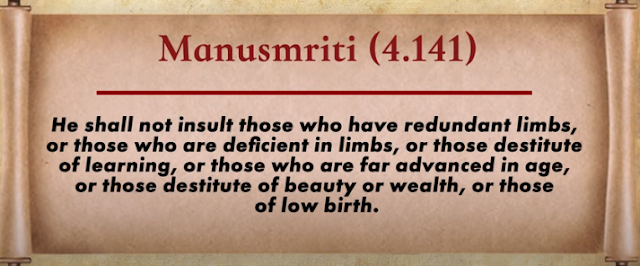
Things went awry when the Manusmriti came along. It is the text of the Brahmins, to put it bluntly. It is not without merit as a handbook of conduct, but it sets up the premise for elitism. Shloka 1.92 clearly states the purity of he who arose from the mouth of Purusha. The remainder of the text is about the conduct of those born thus. As stated, the conduct indicated is actually of strong spiritual and even chivalrous nature. For example, women of the household are to be respected and honoured else the home become godless and also...


Yet, throughout the text, there is a clear injunction against mixing with those of lesser birth. This single document, dating from about 2000 years ago, can be held responsible for the rise of the social classifications that have trapped people by birth rather than their talent. Completely opposing the description of the Vedic hymn which preceded it. Indeed, throughout the Vedas, the Purusha Sukta is the only place where there is any reference of this kind. What is more, even in Manusmriti, there is no talk of all the various sub-categories that have arisen as each within any given varna has sought to improve their stance and only the society itself came up with the concept of untouchable. Trust the human critter to take something noble and screw it up. The Bhagavad Gita (and other texts) attempt to correct this, but those in power do not give it up easily.


Anyway, that's rant enough. Back on track, and this is where we hark back to last week's post on karma. Following the Vedic depiction of us all having the abilities within us, exactly which becomes dominant depends on the karma we have to serve out. We may be born high according to our tendencies but may not live to the fullest spiritual potential in this birth due to the jiva's lessons yet to be learned.

Why tell all this concerning my time at Sandeepany? It had to be faced. Advaita Vedanta as a philosophy rises above such things and is truly inclusive and universal. However, I was in India, amongst Indians, and the majority of them had been exposed only to what might be termed the negative side of Hinduism. A fair few of the young men received reprimands at different times for conduct not conducive to their Advaitic intentions. No fault of their own but arising from upbringing being hard to deny. Also, (and here I tread a little carefully), our upacharya of Sanskrit and pujas was definitely old-school. His big heart of Love had difficulty letting me touch his feet because all his upbringing and experience was that I fit into the Dalit (untouchable) category; I was an unmarried female, unclassified despite having been accepted for attending Sandeepany and white. 

There was some mischief that took place indirectly, perpetrated by some of the young male students who attended Samvid-ji,  that did cause me sufficient concern to take that worry directly to him. Not because I expected there would be any action, but because I wished him to be on alert that this was unbecoming of Sandeepany. Had it continued, I would have gone to the Acharya, but clearly, this tiniest of protests took effect. It helped, too, that we were approaching our first Christmas, and Acharya-ji was singing my praises. 

Outside the ashram, I was a figure of bemusement for many. There are so few non-Indians who last long in gurukula! As time went on, the respect rose, and barriers were broken.

Menoculayshunal; Being You

As begun last week, we are now in the territory of having to explore some of the tenets of Advaitic philosophy within this memoir to give context to the experience of Sandeepany and ashram living based upon said philosophy. In that post, attempts were made to convey something of the effect upon me that brought me to this PhD level study in the first place. Remember, this was not in a field I had formally studied up till now. I'd begun as an analyst/programmer, went through banking and medicine and yet here I was... the simple fact being that throughout all of those career choices, there was the underlying drive to understand a purpose in life... to understand MY purpose in life. And as I have said before, we can read all we like about another's experience, but in the end, unless we actually expose ourselves to the same circumstances, how can we judge?

The spiritual element arose in childhood, and even with some spells of 'darkness,' it never left. How to explain this? Why is it that others, who may indeed have similar experiences, name them differently? Interestingly, two comments of very similar content arose from last week's post; the idea of inherent traits and how one views the spiritual. (Thank you, Gail and Mark!) These were perfect inquiries to lead into today's post - and into next week's, too.

I can feel some of your toes curling at the mention of karma. I am equally confident that this will be due to knowing so little about it. There is a tendency to use the term in conjunction with 'destiny' and give it an airy-fairy, you had no choice quality. However, there is actually a great deal of depth and value to understanding the karmic cycle. Though that, too, offers obstacles to some who get stuck in the idea of coming back to life again and again. But it boils down to energy... and Consciousness (with the capital 'cee'). 

Photo by Monil Andharia on Unsplash
The foundational texts we covered in our early months included Tattvabodha and Atma Bodha. In these are laid down the basic structures of life as described in this philosophy. In the first, we learn what the Rsis understood about matter and its structure; tanmatras are the building blocks - the elements of ether, wind, fire, water and earth. Within these are to be found the anu - the atom... bear in mind that all this understanding arose from meditation and observation and intellectual analysis. Modern-day theoretical physicists, with all their fancy instrumentation and existing scientific breakthroughs, struggle to equal what has already been understood by those mahatmas of centuries past. (We counted among our student batch two PhD astrophysicists, and both were astounded as we progressed to the true depths of our study.) The second text builds upon the first, having established in its process that there is something beyond mere matter from which that very matter arose - the Consciousness, aka, Atma. That Atma is the Universal Soul. Every one of us feels its pull, even if we are not prepared to name it or recognise it. 

The driving factor to our daily living comes from that connection. How aware we are of it depends, according to karmic law, on how frequently Atma has reabsorbed our individualised soul (jiva). Each jiva is likened to the sparks from a fire. They are spat out by the heat of the fire to rise and glow for a while, then darken and fall back to the embers. Some will be rekindled, others not. The sparks are continually thrown until all combustible energy in their substance is exhausted, and there is nothing left to burn. 

No analogy can wholly interpret the nature of the soul, but this goes a long way toward it. We are, all of us, sparks from a single fire. We cannot know how many times we have been 'thrown up' to glow in the dark. Neither is the number of times the same for all. All that we know is the glow that we are currently experiencing. We are all in the praarabdha stage of our cycle. What happens to our jiva selves remains at source (Atma/fire); in its preparation stage, anything that happens to the individualised ember is sanchita. The combination of sanchita and praarabdha give rise to a store of possible outcomes in the future - agami. But remember, at all times, we are the fire only. 

All the sparks - we humans - perceive themselves to be alone and special. There is attachment to the physical being, the emotional being, the mental being - the ego. I-ness and my-ness abound such that when we are falling back toward the fire (ageing, facing 'death') we cling to these things. However, just as actual sparks which go through the flames many times are each time changed and altered, so is the jiva. Some jivas come to understand the cycle, while others are still not enough burned and tempered. We cannot all be at the same level of experience within karma. We cannot all appreciate that karma is the process of constant work, as our jiva is refined as a jeweller refines a diamond.

To be continued...

Menoculayshunal; Being Me

... the challenge of conveying the experience of Sandeepany is getting down to the whys and wherefores of my being there, as well as its effect upon me. The closer it gets to being directly personal, the tougher becomes the task. This is not an autobiography as such - a memoir being merely a historical account or an essay on a learned subject from a personal perspective. Yet, to properly communicate the purpose of the whole exercise, it becomes autobiographical. 

On a couple of occasions, I have wondered why I am bothering. Then I remember that, firstly, a few folk had shown curiosity to know more about this background. Then, that I need to write it for myself. There is much still to be fully digested from the experience, so there is a level of catharsis from producing these posts. 

We are also entering the section where the philosophy I went to study with such intensity spills over into the living of the life. As I departed the ashram, Acharya-ji's parting words to me were, "don't forget to teach, amma!" The thing about Advaita is that one doesn't have to be standing before a class of eager students to 'teach' - one merely has to live life by the tenets provided, and the light shines. Those of you who read yesterday's LLL quote and responded to it understand this. Those of you who enquired and questioned me over the years are all, in a sense, students. But we have to start with the doubts...

There are so many who will claim to not being spiritual. A ridiculous claim when it is an intrinsic part of what makes us human. Any time that a nod is given to an act of compassion, and appreciation is felt for the sight and sound of nature; any time a hand is offered without expectation of reciprocation, or a sense of empathy arises; whenever we stop for a moment and grasp the very essence of being human at all... that is our spiritual selves at work. All too readily, we seek to rationalise such experience or justify ourselves, as if embarrassed to admit such feelings. We are all at different stages of understanding the spirit and what that means to live life. For some, it plays only a minor part, being there only for escape. Going out for a walk or a swim or to a gallery or performance is denied as being anything other than an interest or hobby. The essential part these things play in keeping us balanced in our personality is actually spiritual. How often now do you see reference to the benefits of these things to the psyche? What is frequently unacknowledged is that the "psyche" in question is our spiritual selves. To what level we can see this depends largely on where we are on our karmic cycle... more on that next week.

Back to the me in this.

The calling has been with me since my earliest memory. There has never been any doubt in me that there is a part of life that is forever unseen by the physical eye; that can only be perceived by the spiritual self. Then there are the spilling out or interconnections with that other which simply defy explanation... and tend to be written off as delusional or at least fanciful. I am not going over the same territory covered before. Now I need to pick it up directly from Sandeepany.

Life having deposited me in this place, I had to ascertain the fullness of purpose and come to terms with expectations - my own and those others had of me. This existed because my Chinmaya community in Sydney expressed their support and desire to see me return in the yellow robes of mission-hood. I also saw this as a goal. First, though, the length and depth of the philosophy of Advaita Vedanta had to be explored - not just academically, but in practice.

It was incredible to find myself in a place that totally accepted the likelihood of darshan - visions of the divine. Not that one announced such experiences willy-nilly. However, over time, as a bunch of strangers melded and became family, these things gradually emerged, and it turns out that at this level of spiritual pursuit, such revelations are more than one would think. Not common, definitely not that. But frequently found among advanced seekers and meditators. 

Interestingly, one also learned quickly to know when the shared experience was genuine or when someone was tending to ... embroider. Yes, even among these chosen few, some felt the need to boost their own ego, thinking they might be considered unworthy if they hadn't actually had a darshan of some sort!

I mentioned meditation there. This is a key component of following the Advaitic life. Some days, we were kept so busy that finding even fifteen minutes for meditative practice could be difficult. Before too long, though, I learned that going to Saraswati Nilaya early (say half an hour before class) and taking up position on my aasanda (seat) afforded the best space for this. Surprisingly effective actually, given that there was not the silence there which might be found, say, in the mandir. Which was a proving, too. The ability to be meditative in the melee of life is a key component of living life lovingly. 

There are four guidelines for daily practice (the saadhana chatushtaya); viveka, vairaagya, shamaadhi-shatka sampatti, and mumukshutva. These are utilised individually but are also mutually supportive.

Viveka is to have discrimination - to be able to see clearly what is and what is not. It utilises the intellect.

Vairaagya is the art of withdrawal - knowing when the mind is getting carried away and pulling it back into line, knowing when the senses are becoming overloaded or lustful, and pulling them back into order. This is to help the intellect remain focused on its practice of discernment - but also that viveka guides the decisions regarding vairaagya.

Shamaadhi-shatka sampatti is the six-fold virtues; shama (control of mind), dama (control of senses), uparati (to look inward and upward), titiksha (forbearance, fortitude), shraddha (solid faith), and samadhaana (meditative focus). The practice focused on these virtues will bring about viveka and vairagya through diligence.

Mumukshutva is to have a burning desire to work one's way through these virtues to reach the highest level of spiritual understanding.

Nobody was at Sandeepany without having proven to one of the mission swamis that mumukshutvam was present. I had first learned of these guidelines while studying the Vivekachoodamani in Sydney. A handbook of human understanding that remains one of my all-time favourites. How could it not when, among other things, it makes clear that all the rigmarole that so many put around "spiritual practice" cannot ever bring them closer to that which is worshipped. All that can do so is the application of clear thinking.

Advaitic philosophy is the underpinning of Sanatana Dharma, but - as with so many other faith structures - the Knowledge can only really be taken on by some. All others are too busy fighting life to pay attention or too caught up in the processes and trimmings of faith or the dogma of the spiritual leaders to whom they acquiesce - encumbered (as F/Tigger suggested in their comment last week) in levels of religiosity that are little more than superstition. Or, equally, dogmatic against any and all spiritual practice.


What I was finding in this philosophy was not only all the basic sciences (the atom was posited and understood by those ancient seers who had no instrumentation!) but the fullest, broadest, deepest level of psychology that no modern psycho-theorist can better. Advaita promised to provide the sort of insight that I was instinctively drawn to. It confirmed many of my own observations and helped me go beyond and dig out the parts of myself that needed to be dropped and balanced. Being at Sandeepany was like being at the airport; my practice (passport) had brought me this far, all I needed now was the 'visa' to moksha (nirvana)!!!