WYSIWYG

What You See Is What You Get. This is a journal blog, an explore-blog, a bit of this and that blog. Sharing where the mood takes me. Perhaps it will take you too.
Showing posts sorted by relevance for query karma. Sort by date Show all posts

Meno-K-you-pay-shunal; It's a Give 'n' Take Thing

Karma - action and its consequences.

Just about everybody has heard the word karma and is likely even, at some point, to have used it in some context. The basics of 'what goes around comes around' are understood, but beyond that, most people are rather ignorant of the full implication of the word. It gets bandied about as meaning 'luck' or 'retribution'. This sort of skewing of words happens in every language. Take 'gay', for example. This perfectly innocuous English word used to encapsulate the whole concept of 'happy, bright, cheerful, joyful, festive-like' and so forth, was at some point applied to a person who displayed these characteristics and it caught on as a reference to a male person displaying effeminate and extrovert tendencies. Gradually it came to be synonymous with homosexuality. Now it has been almost entirely usurped. 

Karma, (pronounced 'kurmuh' and not kaarmaa), is multileveled in its concept. Yes, at life-level, it definitely refers to 'be careful what you do less it return to haunt you'. However, that is just the very tip of it. That part is the starting point for what becomes not only a full-life effect but a whole-spirit (many lives) effect.

When we use karma in the Western context, we are often referring to someone getting their just deserts - according to us. It is not for us to judge, however! Karma is for us to pay attention to ourselves. At this first level, it is to be remembered in every thought, word and deed (kriyaman karma - 'working'). With the understanding of the broader implication of karma, we are more likely to make better choices and efforts in our interactions and work. This alone is worth incorporating as part of our daily travel. Whether or not we subscribe to the whole jiiva and punarjanman (reincarnation) concept, at the very least, there is an expectation of being the very best human being that we can be and that involves constant self-assessment in exercising judgement of the sort which is indicated by karma at the first level.

Being clear, then, karma is not about pointing fingers at others and wishing it upon them, but about our own responsibility to ourselves.

Neither is it something to be blamed when things are not going our way. Indeed, it may be that karma is at work when we are having a 'bad run' in life. However, it is at work at all times in life. Every minute of every day is about karma. It is not for the fatalistic, surrendering their power of self-determination. It is about knowing that we alone are responsible for the ripples we make.


Karma is our 'account' in the Bank of Existence. As soon as the jiiva hits its material target** it brings with it a 'balance' (sanchita karma - 'retained'). There are things which happen in life for which we raise our hands and beg the question 'what did I do to deserve this?!' The answer will lie in that balance. It could be that something done in an entirely different existence, in an entirely different place and time, has yet to reach its fructification, and this life is where it happens - good or bad (praarabdha karma - 'destiny'). 
Now for a major statement; there is no such thing as luck. There, it's out. What there is, is the movement of a currency called karma. Not talking here of the cheap 'n' nasty kind of luck some pine for in gambling - that's about numerical odds and luck doesn't come into that either, but that's a whole other discussion. No. This is the 'luck' of life events; job of one's dreams - or nightmares; a home - or not; True Love - or lust and pain… There is a Scottish saying, "what is for ye willnae go past ye." We all get what we have earned in our karma account. It is prudent, then, for an alert jiiva to attend to each thought which arises, how that thought transforms into action, and to consider the cost first to itself and then to others with whose karma it may have intersected.

Closely related to this process is the work of the vaasanas. (These will not be discussed in this series of articles so that link is highly recommended.) The context of the 'grooves' of our personality in relation to karma is that, where karma is the actual currency, vaasanas are the process of transaction. Most philosophies will advocate dropping 'bad habits' and forming better ones when embracing self-growth. In Vedanta, it is referred to as 'burning the vaasanas'. Work out your own motivations, the drivers behind your very thoughts, those are the vaasanas - the seed desires - and sift them, refine them, clarify them. Remember, every action we take has a desire behind it. Every action.


**considered to be at the time of conception. There is a tendency for medical science to claim that consciousness is not present until after birth, but what is actually being referred to is cognitive activity. Additionally, there are various arguments as to how early this hits. Recent research claimed 'surprisingly early logical ability' for babies… most mothers would not be surprised by this 'news'!  


MenoSundays; Life Lived Lovingly


Thank you for responding to last week's intro to exploring The Law of Karma. This is such a vast subject, not one that stands solo. Whilst these posts arise from the teachings of Advaita Vedanta, there is a universality (secularism) to the principles that can be recognised, regardless of one's background or philosophical leanings. It is a challenge to "nutshell" the concepts, and questions and doubts will certainly be raised - and that is fine! Advaita welcomes the questioning mind, the searching spirit, and the doubting intellect. 

In many respects, it is as simple as 'what goes around comes around'. Accepting that action executed, every decision taken, must undergo its consequences, whether expected or not, is a little more complicated.  Firstly, we have to absorb the concept of vaasanas - the impression left by experiences. These are the 'programming' of our individuality. As long as we work on our vaasana instructions, we will be caught up in desires, agitations, and the actions resulting from seeking to quell them. The actions will 'imprint' according to the result obtained, which leads to affirming existing vaasanas or creating new ones that will bring on further action.


It is the law of cause and effect that governs karma. Let us look a little closer. Each person is who they are based upon the yield of past actions. From birth through to the end of life, if actions are of noble and pure intent, that person might be said to be one of dignity or goodness. Equally, we see others who live with viciousness and immorality, and we mark these as 'bad eggs'. Everyone has a concept of what is acceptable behaviour and what is not. What drives this is not only the circumstances around them (which can be seen and easily 'accused') but also the very nature of each individual, the personality with which they are born. Hence, we can find 'bad eggs' arising from otherwise agreeable roots, and conversely, we see giants of virtue coming out of the worst of circumstances.

Thus, we can conclude that what drives a person's life is not so much the environment but how they respond to it - and this is ascribed to karma. We can look at this and say, 'Well, that was their destiny,' and leave it at that. How lacking in curiosity would that make us?!

Karma is not simply destiny (which has the sense of being written in stone, and therefore, nothing can be done about it). It is much more dynamic than this. To fully understand karma is essential in Vedanta, for it clarifies how we even have come to be reading the philosophy itself. The 'destiny' part of karmic law is that which is called praarabdha. It is the 'effect' of the causative past in current life and all previous existences. It can be seen that balance has to be brought to bear, deeds answered for, and to this extent, we must live out destiny. However, along the way, each jiva (the individualised soul) has the capacity to climb the spiritual ladder, cancelling out the karmic account and developing ever greater strength to correct the course of praarabdha.  This self-effort is called purushaartha (wealth of cosmic man), and this is the seed of the phrase "Lord helps those who help themselves". Thus, it can be said that the present praarabdha is a result of past purushaartha. Equally, every action from this moment of understanding can have purushaartha behind it to ensure an improved praarabdha as we go forward, leading to final liberation (moksha) from the whole cycle.

In short, what one meets in life is praarabdha, and how one meets it is purushaartha.

We have the power of our future within ourselves. Through our purushaartha, we can really make a difference in our soul's journey. Whether we choose between preyas (path of ease) or shreyas (path of good) may be written at birth according to praarabdha, but if we have earned enough karmic points, we will come to understand that choices can be made to change or improve our paths. We cannot completely wipe praarabdha's slate, but it can be said that the future is a continuity of the past, modified with purushartha in the present.

Now, the mix gets a little more complex. Yes, we have freedom of choice between positive and negative actions in terms of our purushaartha; however, those choices are still largely coloured by the depth of our praarabdha.  Gurudev, Swami Chinmayananda, gave an excellent example of a boat on a river. Without an engine (no choice), it must only flow as the river flows; if we add an engine (purushaartha), we can certainly give the boat independence of the river...but for as long as it remains on the river, despite being more steerable, it is still to some extent governed by the current already in place; thus if going down river the boat is actually going faster than its engine is driving it, but if it is going upriver, it may be battling to maintain speed.  This explains how, even when we have a good and well-planned life, we can hit heavy 'back-currents', and we wonder what we did to deserve the strife!  We may never know the source of the eddy or the whirlpool. All we can do is seek to regain balance through purushaartha, titiksha, shraddha and so on.

We are, then, a product of our past but can be producers for the future. Praarabdha (law of destiny) applies only to past actions and makes us victims. However, Karma (law of consequential action) ensures the ability to create and quell praarabdha. The logic behind this is well seen in present life with things such as education (the more effort put the better the qualification) and such like; what can take a little more to absorb is that there are many, many, many lives which contributed to praarabdha and there may be many more to endure until purushaartha can yield the most favourable result of all - the balancing of our karmic debt and we can sign off the cosmic account.

Yes, I am aware that you are also being introduced to the concept of reincarnation here. However, even in accepting this is the one and only existence we have, does it not make the urgency of positive living, living life lovingly, all the more imperative? Even if we have only these most fleeting "three score and twenty" to display our light of consciousness, is it not better to ensure our actions speak positively for us?


MenoSundays; Life Lived Lovingly


Recently, some very interesting comments were made on the "karma as action" quote. Karma is one of those words that has been adopted into English and somewhat mutated. 

Not entirely: it is true that karma reflects how we have lived our lives, so contained within that is the idea of getting a comeback on behaving badly. It is, though, way more complex than this, so this month, I am going to focus on providing you with a more detailed understanding of karma and how we all live it, regardless of our philosophical base. 

Action is the insignia of life. Man cannot live without actions. Actions by themselves are neither good nor bad. It is the intentions behind them which make them such. For example, when a doctor performs surgery, it is not called assault with grievous bodily harm, even though sharp implements are used, and the body is slit open. It is being done to improve health.  All undertakings in life may be categorised per the triguna (three qualities), depending upon the intentions behind them.

Sattvic; proper and deep thought behind an action makes it a sattvic undertaking. One thinks about the goal that engenders the action and the consequences and/or results that may ensue. One also thinks about the time, effort, cost and so on. Sattvic thinking enables strong prioritising and setting of clear goals. There is also a consideration of the effects on others when carrying out the action or what might arise from it. There is a strong assessment as to whether any given action is a worthy one or, indeed, worthwhile (i.e., is it sufficiently noble or even worth our investment of time, etc.). "Plan out your work, and then work out your plan!" After planning well, when all one's energies are focused on one's actions, it is more likely to be efficient and successful. What is more, if variations and hurdles arise, one is better equipped to deal with them - as our planning ought to contain 'contingency'. The benefits of sattvic action are often sustainable and long-lasting.

Rajasic; incomplete and distracted thinking makes an undertaking rajasic. Actions based on immature or hurried thinking, half-baked plans or overly sentimental promptings often fall short in terms of purpose and fulfilment. Having too many goals (multitasking) is likely to result in a lesser standard of completion...the term 'jack of all trades and master of none' was made for such as this! Improper thinking, procrastination, disorganisation, and stress… all arise in rajasic action. Undoubtedly, things will get done, but often without appropriate satisfaction, and the benefits will likely be short-term.

Tamasic; rash, whimsical, indiscriminate, impulsive...these are words often associated with tamasic action. The term 'act in haste and repent at leisure' would apply here. Often, tamasic action is driven almost purely by strong emotion, logic having left the building! There is rarely any positive result for such a situation.  There may be immediate gratification, but this is followed by more immediate need, and cycles of guilt, regret, and misery are created.

The aim of life is to always live in the space of sattvic. However, we are all flawed to a degree and thus will all experience some rajasic or tamasic times. Striving for the best is something we can all do. Embrace capital 'ell' Love! 


MenoSundays; Life Lived Lovingly

Over the last three Sundays, we have seen a little of what Advaitic philosophy tells us about karma. The law of cause and effect with respect to our individual life experiences. 

Many of us would like it to be as simple as tit-for-tat. As we've read, though, as with all physics and quantum theories, the simplicity is complicated by so many factors. As with physics and quantum, we can come to deeper understandings as long as we are prepared to put the work into absorbing the necessary strands of learning. For some, this work is thrilling and uplifting. For others, it is a matter of pride and competition. Then, others just can't be bothered with the effort, as there are far too many distractions in life. 

By now, it is hoped, you will recognise the sattvic, rajasic and tamasic responses!

A question may arise as to what is right or wrong about any of these reactions. Advaita doesn't make a judgement on this. We are what our makeup of praarabdha and purushartha (established pattern and efforts to change it) result in us being and what we might become.

That said, no matter which society we are born into and how much difference there may be between all those societies (cultures), in every place, there is a sliding scale as to what is acceptable behaviour and what is reprehensible. This brings us to the question of good versus evil. It raises the spectre of individual responsibility versus the common good. Also, when we dig into it, we find that all societies have a similar idea of what constitutes 'good living' versus ' wrong living'. The world over, we all want to live without hassle, in peace and safety.

Scientifically, we know that everything we perceive is matter. Matter comprises all sorts of building blocks, which, for this post, we shall refer to as tanmatras**. Socially, we know that communities are made up of many individuals. Just as matter can only form shapes/things by the tanmatras forming solid bonds that hold any given item together, so it is that communities can only remain stable for as long as the individuals within it form the appropriate bonds of kinship. All things of matter will erode: the length of time depends upon many things, not least how well the bonds were formed in the first place and what the environment around them is like. The tanmatras will often be taken up and reformed into new items. All individuals within a community will erode according to their health and environment. All humans, it is to be remembered, are made up of matter only. All communities eventually erode, often to be replaced with reformed ones.

A key difference between humankind and all other matter is that our central nervous system has evolved to such a degree that we debate what is good and what is not. Other sentient species on our planet do have social bonds and appear to have determination as to status within their societies, but only the human critter has formed philosophy and advanced strata of laws and statutes to guide the mass of individuals along a communal path of decency.

Every society, then, forms its own philosophy of right and wrong. The basis of all such philosophies is to achieve the betterment of those groups by encouraging the self-improvement of the individuals within the group. 

The human critter has the incredible ability to correct itself.

We are blessed with the antaH-karana**, the four-fold processing unit most commonly referred to as the mind. Again, one word loses the subtle complexity!

Back then, to our individual karma—our tale of action. What needs to be understood is that action is the result of a process that begins with the seed of a desire in the individual. From desire arises thought, first of the 'I want...' variety and then quickly supplanted by the 'do this or that to get it' thoughts. Then, action arises. What action we take must result in a corresponding reaction in the jiva's timeline - it might be immediate, such as indigestion due to overindulgence as we satisfy our food desires, or very long-term. Neither should we think that karma means 'bad things happen to bad people.' There is positive karma also - and none of us is free from it. Simple physics. Cause will always have effect.

It is important to understand that the matter of which we are made is totally neutral. The physics/quantum nature of our existence has nothing to do with the quality of any action. The goodness or badness of anything is a concept held only within the intellect. By becoming so aware of our existence, we have also had to contend with the consequences of that awareness. It is the very essence of what makes us 'human'.

The next point to understand is that this is not a static thing. Our concepts of what is right and wrong have mutated over the centuries. Actions that were once celebrated—like the persecution of religious minorities or the subjugation of other races—are now widely recognized as evil. This didn't happen because the physical world's moral character changed but because human society evolved in its understanding. We can, through a study of history, also recognise there is a cyclical nature to such behaviours. Whilst societies may learn and seek to move the human race along a better path of community collaboration and peace, it will only hold for as long as the balance of individuals within it opts to follow that path.

This brings us to the wider karmic cycle. Communities will always reflect the majority tendency of the individuals within them, which is when we start to see cliques. This is why we get 'desirable residence' areas versus those that are feared or jeered. 


As individuals, we have to determine how we wish to behave in the world. Are we prepared to stretch ourselves and seek to live life lovingly, no matter how strong the tide is currently against that? Can we fund the moral fibre within ourselves to spread capital 'ell' Love by being the example - not by preaching, thumping, threatening, but by accepting that there are many streams feeding into the river of Love and letting it flow? 

**Tanmatras, antaH-karana... the first is the name given to the elements in Advaita - which looks at the physics of creation as much as the metaphysical; the second is the exploration of what makes the human psyche. If you have found this month's series of posts interesting - would you like posts on these also? Thank you to all who have read and responded.

MenoSunday; Life Lived Lovingly

Over at Aatmaavrajanam blog, we have been working through the Narada Bhakti Sutra on 'Workingsday' of each week. Bhakti is the Sanskrit word for capital 'ell' Love. The beauty of Bhakti is that it is readily recognizable, whatever one's background or belief system. This post is a direct lift from AV-blog, as it really describes what we are after here! 


Hari OM
Application - that is what 'Workings-days' are about!

The Narada Bhakti Sutra is our guide for a while… the nature of Love (with the capital 'ell') and a full exploration of it. As always, you are encouraged to seek out the full text from Chinmaya Publications (links in side-bar); but for those who prefer e-readers, this version is recommended. Whilst awareness and interest can be raised by these posts on AV-blog, they cannot substitute for a thorough reading and contemplation...and practice!

We now move on to Chapter 2, Section 1, which has three sutraani giving rationale as to the greatness of Bhakti. The first two are very closely linked, so will be given together here.

sa tu kmR}anyaege_yae=Pyixktra.25.
Saa tu karmajnaanayogebhyo-pyadikataraa ||25||
)lêpTvat!.26.
Pfala-ruupat-vaat ||26||
That (Supreme Devotion=Bhakti) is indeed as a technique, even superior to the paths of action, knowledge and disciplined contemplation.
(Because) it is of the nature of the fruits of all yogas.

The four yogas/paths for attainment of spiritual perfection are Karma (action), Bhakti (devotion), Raaja (aka Hatha - keeping body disciplined) and Jnaana (Knowledge). It is generally accepted that each sadhaka must find the path which suits their circumstances and temperament best. Each yoga, quite naturally, will put arguments forward as to why it may be considered better than others - but this can only be true if the seeker is fitted for it. Any worthwhile and dedicated seeker will actually give all a chance in order to find the best fit for themselves - at no time is another to be considered greater or lesser, actually. The goal of all paths is exactly the same, only the means differ.

Image result for love divineBy extension the same can be said of each religion. As long as the focus is the Higher, whether we choose to worship in a church, a mosque or a temple is irrelevant. The importance is that faith, hope and charity flourish. In applying these, each individual can raise themselves spiritually. Even, it may be said, those who proclaim agnosticism or atheism, if they apply the highest human principles which can still be said to be the three (ie faith - in the basic good of human nature; hope - that all the human race can improve itself; charity - caring for other humans around one), can benefit from the teaching of Narad-ji. For you see, the one thing which underpins all of these is capital 'ell' Love. Let us think a little more…

Karma - this path is not only within Hinduism; in every community we find that those who act selflessly are revered. Awareness of one's activities and dedicating them to the betterment of one's family/community/nation is Karma. Do we not all know people like this? Do we not measure ourselves against their actions? Whether or not they proclaim a faith structure as the anchor for their actions matters not. What is important is that they had the Love inside to act selflessly.

Raja - no doubt keeping the physical being as healthy and fit as possible, treating the body as the temple, enables our actions, frees the mind from worry about health and is a very visual indication of dedication. Again, this is not just an Indian thing - all cultures value physical fitness, is it not? Not always unselfishly though and there is danger of it becoming very selfish, in fact. In and of itself, it benefits only the practitioner - however, if they are feeling well, they are more likely also to be feeling happier and that is generally better for those with whom they socialise. The greatest benefit from Raja, however, is when the love for the physical is practiced with, and transforms to, Love for the Higher.

Jnaana - where in the world is knowledge not considered worth the having? Nowhere. The term 'jnaana', however, is rather specific to Hindu tradition in that it refers to capital 'k' Knowledge of the Self. In working towards that, all other knowledges will accumulate. The Sanskrit tradition is that complete Knowledge was given in gurukula and there was no separation. Somewhere in history, the material knowledges (science, art, engineering etc) got separated out as being of more value to life. The science and art of living became something of a casualty. Jnaana-marg requires that we reconnect with the original purpose of study and to do this we require an element of Love for the Higher possibilities in life.

Bhakti - Love, however, stands alone. It is present in each of the preceding when they are working at their best - indeed it could be said that the first three are empty and pointless without the presence of Love - but Love Divine can be present without the other three. Each of the first three are saadhanas which require specific actions, tools, methods, understandings and so forth. Love only requires to 'be'. Love has to be present for selfless action, for applied dedication of the body and for the subject being studied. Love is therefore already present and waiting to be taken up; Love must remain for full benefits to be obtained; and Love continues even when the other three are done. Love is an expression of Higher Self.

This is why Narad-ji argues Bhakti is the greatest after all. Even the heartiest atheist cannot argue against pure, unselfish, no-ties, unconditional, all-encompassing Love!

$ñrSyaPyi_amanÖei;Tvat! dENyiàyKtTvaCc.27.
Iishvarasya-apy-abhimaana-dveshitvaat dainyapriyak-tatvaat-cha ||27||
Also because of God's dislike for egoism and because of His love for meekness.

The Guru furthers the argument with the authority of the Divine itself. Iishvara is the name given to the god-principle with which the majority of the world is familiar - the God with human-like qualities and therefore having preferences for our behaviour. However, even if one does not accept a theist view, the concept of ego versus humility is not difficult to accept as a guiding principle for our own behaviours. The minute we allow ourselves to become vain about the good actions (…"after all I've done for them!"…), over-proud of our physical disciplines (…"see how many reps of gym I can do?!"…), or possessive of our knowledge (…"what does s/he know? I have so much better understanding"…) we are in trouble!

It is not that we cannot have a sense of worth and value in all these things. We must. However, the moment we start to feel the pricks of competition, jealousy, arrogance and so on enter our thinking with regard to what we are doing, we are lost to our ego. Egoism doesn't have to mean bullying and boastfulness - it can be the inverse, whereby self-esteem plummets and we are all the time thinking everyone else is better than us. It is still seeing life as a competition allowing our ego-self to dictate our nature and, from the psycho-spiritual perspective, this is very unhealthy. 

Love Divine does not wish this upon us. Love Divine can bring us out of such bleak behaviours. All that is required is surrender of that part of the ego which seeks to separate us from living fully in the shining light of Love.

Meno-Spirito; Soul Interpretation (pt 3)

The last two Thursdays, an exploration of 'what is in a name' has been undertaken. It arose from a simple question; 'what do you prefer to be called?'

We all identify with our names, is it not? One of the worst tortures which can be inflicted upon a human is to strip them of their name and assign a number. We can be left with nothing else, but our name holds us in place. Our name is a written expression of our ego-self, the independent personality which makes 'me' different from 'you'.

Image result for what's in a nameIn Western culture, for the most part, names are assigned according to family heritage, Biblical tradition or because Daisy the milch cow walked on the road and caused us to be born in the ambulance. There has been a surge in 'made up' or 'filmi' names being given to children. Hands up those who have cringed and said 'ooh how could XXX do that to their kids - imagine having to live with that name?!' This is because we all have a sense that a name matters, at the very least in a social context, and that to be different may have some emotional or psychological effect.

Rarely do we go beyond that though; and certainly, most parents in Western Culture will decide for themselves what to name their children.

Indian parents, (though this is starting to change somewhat), will consult their parents, then the family priest and, if pundit-ji is not himself a jyotisha ('astrologer' yet more), then call in an independent jyotisha.  Why? In order to ensure that the karma of the child, as determined by surprisingly  advanced mathematical formulae, is improved in this life, that the name will help pay off karmic debt whilst neutralising some of the forces which might incur further 'debt'.

When Indians introduce themselves to each other, the name will automatically be 'clocked' somewhere in each others mind - if not actually commented upon. There are many names which are 'common' insofar as they are numerologically 'safe'; for example Asha (Hope) or Priya (Beloved)... what destiny could not be improved with such names?! However, when the less common names come along, such as Yamini, the little grey cells of the person one has just made pranaams to are working on what kind of karma you are carrying and will it interact with them!

The other aspect is that each person takes seriously the praarabdha engendered by their given name and seeks to maximise its positives and minimise the negatives. In this way, 'self-improvement' is built in to the very fabric of being. It is the key to cultural difference of those who follow Sanatana Dharma and all others. Everything in every day becomes sacred; not in an overt, stylised fashion, but subtle and light. Does it suggest no free will? Of course not! Whilst we do have to pay debts from this and all previous incarnations, how we do that is left entirely up to us - or else there would be no need of 'karma' at all. The essence of it is that we are left to our own devices, but must live with the consequences. This engenders, it is hoped, increased levels of self-responsibility and high values, in order to avoid falling down the ladder of evolution.

Image result for what's in a name

How did we come to this esoteric point in response to a simple question regarding a name? There is no 'simple name', is why. Name is sound. Sound is vibration. Vibration has effects, no matter how incredibly subtle. This applies to all words in every language. Nothing vibrates stronger for us than our ego-name; no matter how humble we may be. This is one of the reasons that monks and nuns are given different names on taking robes. The new name not only means leaving the ego behind, but adopting the values indicated by the new name. In Sanskrit tradition, the idea is to rise above the ego and any name within oneself. The moniker remains only for the convenience of those around one.

What do I prefer? When addressing me in person, Yamini is best, but nothing is lost for being YAM - my initials, hence the capitals and thus the full name in a conjunction representing the whole... something Sanskrit is supremely designed for!

Menoculayshunal; Being You

As begun last week, we are now in the territory of having to explore some of the tenets of Advaitic philosophy within this memoir to give context to the experience of Sandeepany and ashram living based upon said philosophy. In that post, attempts were made to convey something of the effect upon me that brought me to this PhD level study in the first place. Remember, this was not in a field I had formally studied up till now. I'd begun as an analyst/programmer, went through banking and medicine and yet here I was... the simple fact being that throughout all of those career choices, there was the underlying drive to understand a purpose in life... to understand MY purpose in life. And as I have said before, we can read all we like about another's experience, but in the end, unless we actually expose ourselves to the same circumstances, how can we judge?

The spiritual element arose in childhood, and even with some spells of 'darkness,' it never left. How to explain this? Why is it that others, who may indeed have similar experiences, name them differently? Interestingly, two comments of very similar content arose from last week's post; the idea of inherent traits and how one views the spiritual. (Thank you, Gail and Mark!) These were perfect inquiries to lead into today's post - and into next week's, too.

I can feel some of your toes curling at the mention of karma. I am equally confident that this will be due to knowing so little about it. There is a tendency to use the term in conjunction with 'destiny' and give it an airy-fairy, you had no choice quality. However, there is actually a great deal of depth and value to understanding the karmic cycle. Though that, too, offers obstacles to some who get stuck in the idea of coming back to life again and again. But it boils down to energy... and Consciousness (with the capital 'cee'). 

Photo by Monil Andharia on Unsplash
The foundational texts we covered in our early months included Tattvabodha and Atma Bodha. In these are laid down the basic structures of life as described in this philosophy. In the first, we learn what the Rsis understood about matter and its structure; tanmatras are the building blocks - the elements of ether, wind, fire, water and earth. Within these are to be found the anu - the atom... bear in mind that all this understanding arose from meditation and observation and intellectual analysis. Modern-day theoretical physicists, with all their fancy instrumentation and existing scientific breakthroughs, struggle to equal what has already been understood by those mahatmas of centuries past. (We counted among our student batch two PhD astrophysicists, and both were astounded as we progressed to the true depths of our study.) The second text builds upon the first, having established in its process that there is something beyond mere matter from which that very matter arose - the Consciousness, aka, Atma. That Atma is the Universal Soul. Every one of us feels its pull, even if we are not prepared to name it or recognise it. 

The driving factor to our daily living comes from that connection. How aware we are of it depends, according to karmic law, on how frequently Atma has reabsorbed our individualised soul (jiva). Each jiva is likened to the sparks from a fire. They are spat out by the heat of the fire to rise and glow for a while, then darken and fall back to the embers. Some will be rekindled, others not. The sparks are continually thrown until all combustible energy in their substance is exhausted, and there is nothing left to burn. 

No analogy can wholly interpret the nature of the soul, but this goes a long way toward it. We are, all of us, sparks from a single fire. We cannot know how many times we have been 'thrown up' to glow in the dark. Neither is the number of times the same for all. All that we know is the glow that we are currently experiencing. We are all in the praarabdha stage of our cycle. What happens to our jiva selves remains at source (Atma/fire); in its preparation stage, anything that happens to the individualised ember is sanchita. The combination of sanchita and praarabdha give rise to a store of possible outcomes in the future - agami. But remember, at all times, we are the fire only. 

All the sparks - we humans - perceive themselves to be alone and special. There is attachment to the physical being, the emotional being, the mental being - the ego. I-ness and my-ness abound such that when we are falling back toward the fire (ageing, facing 'death') we cling to these things. However, just as actual sparks which go through the flames many times are each time changed and altered, so is the jiva. Some jivas come to understand the cycle, while others are still not enough burned and tempered. We cannot all be at the same level of experience within karma. We cannot all appreciate that karma is the process of constant work, as our jiva is refined as a jeweller refines a diamond.

To be continued...

Menoculayshunal; Being We

Picking up from the thread of who we are and why we are, it is now time to look at the dimension which has become so skewed within its own culture that it is almost a swear word - indeed, as acted out in current form, is a blasphemy.

Caste. On reading that word, you certainly have your own 'take' on what it entails. And based on the goings-on in India, you are likely to be close to the mark. Before chucking stones, however, tell me where there is any society where such social inequalities do not exist. Everywhere there are the academics (Brahmin), the gentry (Kshatriya), the facilitators (Vaishya) and the working class (Shudra), and each will be inclined to 'stick to their own,' birds of a feather and all that.

The word is not appropriate, however. It arose from the early Portuguese traders to India, who perceived the social stratification as being along the lines of racial difference. The Portuguese word for race is casta. The Sanskrit word is varna and actually translates as colour. It does not relate to skin colour but personality - the inherent tendencies that drive our interests and activities.

The ancient and unauthored text called the Purusha Sukta describes creation as the waking and sleeping state of the universe's life force. Purusha is the Universal Man. When awake, everything in the universe bubbles and thrives. When He sleeps, everything sinks back into the primordial. This is a description of the expansion and implosion of the cosmos. 

Then come verses describing the creation of what we know on this earth. You see the key verse in this image. What is to be taken from this is that within any one person are all qualities. We can all be academics, aristocratic or military, businessmen or women or, serve society in those roles that so many consider 'lesser,' yet are so important for the structure of society. 

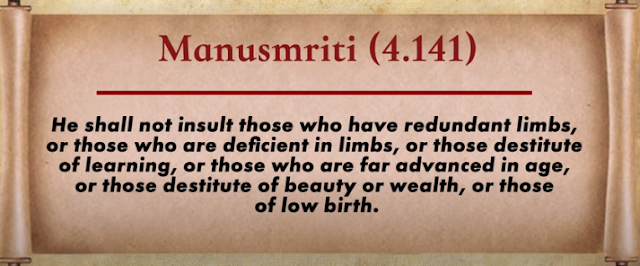
Things went awry when the Manusmriti came along. It is the text of the Brahmins, to put it bluntly. It is not without merit as a handbook of conduct, but it sets up the premise for elitism. Shloka 1.92 clearly states the purity of he who arose from the mouth of Purusha. The remainder of the text is about the conduct of those born thus. As stated, the conduct indicated is actually of strong spiritual and even chivalrous nature. For example, women of the household are to be respected and honoured else the home become godless and also...


Yet, throughout the text, there is a clear injunction against mixing with those of lesser birth. This single document, dating from about 2000 years ago, can be held responsible for the rise of the social classifications that have trapped people by birth rather than their talent. Completely opposing the description of the Vedic hymn which preceded it. Indeed, throughout the Vedas, the Purusha Sukta is the only place where there is any reference of this kind. What is more, even in Manusmriti, there is no talk of all the various sub-categories that have arisen as each within any given varna has sought to improve their stance and only the society itself came up with the concept of untouchable. Trust the human critter to take something noble and screw it up. The Bhagavad Gita (and other texts) attempt to correct this, but those in power do not give it up easily.


Anyway, that's rant enough. Back on track, and this is where we hark back to last week's post on karma. Following the Vedic depiction of us all having the abilities within us, exactly which becomes dominant depends on the karma we have to serve out. We may be born high according to our tendencies but may not live to the fullest spiritual potential in this birth due to the jiva's lessons yet to be learned.

Why tell all this concerning my time at Sandeepany? It had to be faced. Advaita Vedanta as a philosophy rises above such things and is truly inclusive and universal. However, I was in India, amongst Indians, and the majority of them had been exposed only to what might be termed the negative side of Hinduism. A fair few of the young men received reprimands at different times for conduct not conducive to their Advaitic intentions. No fault of their own but arising from upbringing being hard to deny. Also, (and here I tread a little carefully), our upacharya of Sanskrit and pujas was definitely old-school. His big heart of Love had difficulty letting me touch his feet because all his upbringing and experience was that I fit into the Dalit (untouchable) category; I was an unmarried female, unclassified despite having been accepted for attending Sandeepany and white. 

There was some mischief that took place indirectly, perpetrated by some of the young male students who attended Samvid-ji,  that did cause me sufficient concern to take that worry directly to him. Not because I expected there would be any action, but because I wished him to be on alert that this was unbecoming of Sandeepany. Had it continued, I would have gone to the Acharya, but clearly, this tiniest of protests took effect. It helped, too, that we were approaching our first Christmas, and Acharya-ji was singing my praises. 

Outside the ashram, I was a figure of bemusement for many. There are so few non-Indians who last long in gurukula! As time went on, the respect rose, and barriers were broken.

Me-noT-good

tms!
Tamas - darkness

We all of us have tamasik phases in our lives, but one notable time which can be generalised is our teenage years. Few escape it.

Rebellious to authority, indolent and entirely self-absorbed. Seeing the dark side of everything and struggling to see the positive. Seeking to live only through the senses and desires. Tamasik-dominant personalities contribute little to society. They are the vice-prone, easily-led characters who are looking for cheap thrills, to escape 'real life' and to work as little as possible to gain as much as they can. There is no caring and sharing in this personality trait. This is why it was said earlier that it is difficult to think of this as a 'virtue' as per the term 'guna'. However, it is karma at play, and the jiiva is learning lessons, experiencing consequences and furthering itself along the greater course of karma, and this is a virtue for sure. The quality of tamas is, of itself, certainly not virtuous!

To have a 'slob day' every now and then is fine. Have a weekend without showering, cooking or even getting dressed. It can relieve tension… but consider instead having a sattvik weekend, where you seek to raise vibration for release from stresses by walking in nature, reading a good book, share good conversation, instead of sinking into self-pity and sloth. The danger of tamas is that it captures us and holds and is much more difficult to withdraw from. It is easy. Sattva, on the other hand, requires discipline and effort and unless we can see the value, it does not hold us. After a sattvik weekend though, we generally find ourselves refreshed and ready for another week of whatever the world throws at us. If we have sunk into tamas, we are rarely revived, often hung-over from one thing or another. We do not feel good about ourselves.

Tamas has a propensity for foul entertainments such as 'slash movies' and horror/terror in general, "reality" tv, and disturbing music. It will look for mind-altering substances and make inferior food choices.

Any food that is stale, which is overripe or not ripe enough, food that is fermented, tasteless or rotten, 'fast' foods, supermarket ready-meals…
  • Meat
  • Onions
  • Garlic
  • Mushrooms
  • Alcohol
  • Vinegar
  • Bread (yeasted)
  • Cakes
  • Pastries
  • Canned foods
  • Frozen foods

Some of these look the same as for the rajo-guna. However, it is a matter of scale. In rajas, it is possible to take meat lightly, and less alcohol, for example. In tamas, these foods start to rule our lives. They are addictive, and we do not stop to assess the quantity we are consuming. We may not realise it, but a predominantly tamasik diet can make us angry and greedy, can even affect our decision-making process for the worse and compromise our judgments. 

To raise ourselves from the tamas we need to incorporate more rajas. To lift ourselves from rajas we need to integrate more sattva. Sattva and tamas, to the casual eye, can look very similar. Both will not be particularly interactive with the world. However, the difference will be that sattva sits straight and alert, even in meditation, whilst tamas stoops and sleeps in meditation. Sattva misses nothing, tamas misses much. When something needs to be done, sattva will act accordingly, tamas won't even see the need.

Tamas is represented by the colour black.


MenoSafe and Sound

sÅv
Sattva - spiritual essence, vitality, courage, existence… (long list!)

The simplest way to describe the sattvika nature is 'pure'.  Every single one of us is born sattvik. Then the sanchita karma kicks in and determines whether we retain that or have to work through our vaasanas in the state of rajas or tamas. Regardless of our current state, if we are not already in a sattva-predominant nature, then we can make efforts to reach there.

What is sattva and why would we want to be it? The sattvika personality knows how to be still, how to be quiet. Sattva is cheerful and accepting, content and unperturbed. It can see the troubles of the world but does not carry them. It moves only when necessary, takes only what is required, seeks to return more than was taken. Sattva is capital 'ell' Love, it is compassion and able to provide a haven for the hurt and needy. Sattva is serene, watchful, has no desire beyond spiritual gain. Sattva is clear about what is "I" and what is not. It knows how to be in the world but not of it. There is detachment and clarity. We can all find a bit of the sattva within us at times, but to be classed as sattva personality, it needs to be instinctively present.

How do we work towards more sattva in our lives? Less careless living; instead, listening to uplifting music, reading fine literature and philosophy, films which carry a message of high human values. Embracing the quiet; appreciating nature, little moments with friends and family, learning to make appropriate boundaries between work and self-time, keeping better company. Taking up self-improvement; be prepared to self-assess without ego, spend time with ourselves to do that, watch for the excuses as to why not…

Then there is the diet;
  • These are foods that are nourishing, soothing and help sharpen the mind, making it more aware and active.
  • Sattvik foods are vegetarian and eaten in moderate amounts.
  • These are foods that are free of chemicals, preservatives, artificial colours and flavours.
  • Processed foods generally are to be avoided - these days, there is an argument for the use of frozen items and organic canned goods - but these should be used minimally.
  • Organic and fresh fruits and vegetables that have been grown and picked with love. More and more we can source our foods if we don't grow them ourselves.
  • Whole grains, such as buckwheat, barley, rice.
  • Nuts and seeds.
  • Beans and lentils of the lighter variety; butter beans, broad beans, green beans, peas, moong dal, chana dal etc.
  • Dairy products like milk and ghee.
  • Oils mostly derived from plants; coconut, mustard, sunflower.
  • Foods that are not overly sweet; honey or sugar of minimal processing, such as jaggery.
  • Spices which are beneficial for the body and mind; turmeric, cardamom, paprika, coriander, cinnamon, fennel, cumin…


Many will read this and say 'oh, that is the government standard for healthy living.' Which is true, many countries now understand the need to eat better quality and less quantity and encourage their citizens to this… but the ayurvedic diet has been around for millennia. Nothing new under the sun!

To be sattvik is to walk upon the earth lightly, to be ahimsa. It is represented in the colour white, in which all colours unify.


MenoSundays; Life Lived Lovingly


Continuing this little series of posts on the Law of Karma. This one is a sort of summary (summation?) of the first two posts...

Gati - results (hereafter)

Every action has an equal and opposite reaction... 'as we sow, so we reap.'  The results of mental, verbal, or physical actions are;
a)  the joy or sorrow that we experience while doing the action
b)  the impression, good or bad, which it leaves within us (vaasana)
c)  the outer results we get in terms of circumstances, which fructify in their own time. Some results of action are immediate, whilst others may not come till some time later, such as weeks, months, or years. Still, others may take lifetimes to be exacted upon us.

During our lifetime, we enjoy or suffer the consequences of all actions done in our past, be it within this life or any of our past lives. All actions create vaasanas in our minds. At the time of death, the predominant vaasanas from this and earlier lives are drawn together to determine the quality and 'texture' of future incarnations; the vaasanas also determine the type of body and the field of experience we shall obtain hereafter.

Sattvic; at the time of death, a predominantly sattvic mind goes on to gain the highly subtle body of a presiding deity and enjoys subtle fields of experience... or he may be born as a human being and enjoy a high standard of living or gain a sattvic environment in which to fulfil the sattvic vaasanas brought into life.

Rajasic; a predominantly rajasic mind at the time of death, manifests as a human being in an action-oriented environment where he can exhaust his vaasanas of indulgence and activity.

Tamasic; a person with predominantly tamasic vaasanas at the time of death, manifests as a human being in an inert or poor environment or as some form of animal or plant; there, he can exhaust his vaasanas of inertia and live in a state of non-thinking.

From this, you would think living a sattvic life seems common sense, would you not? However, you will gather that even the best intentions can go awry if we are not watchful of the vaasanas within us - those grooves of experience that mark us, however subtly. It is also one of the anomalies of life that we very often identify the grooves in others but are less able to see those within ourselves. Very often, it is only when we are faced with our mortality that we properly begin to assess ourselves. Either that, or we continue in total denial of who we truly are! 

Indeed, how you receive the knowledge within this karmic concept will come down to where you lie in the spectrum of saatva, rajas, or tamas. It will be immediately understood, or taken on board, challenged and tested... or totally rejected... This is not a judgment but a statement of fact. We are who we are but we can be something more. Even the best of us can always find something within us to improve. This is the kernel of living life lovingly.


MenoSundays; Life Lived Lovingly

First, we were introduced to the antaHkarana.
Second, we understood a little more about the ahangkaara.
Third, came a little more on manas.
The fourth post brought you an insight to buddhi.
Today we shall look at:

Chitta: commonly translated for purposes of the antaH-karana as 'memory'. It does include something of memory built through the life being lived, but here is where things get rather more esoteric. It can also be used to mean 'intention'... or, indeed, any of the following:


Take note of that one translation which reads 'ninth mansion'. What has this to do with our mental faculty, you may well ask. Permit me to provide this quote from Vedic texts:
✤ The ninth house is the house of faith, wisdom, and divine. It is considered to be an auspicious house and reflects the fortune that one has accumulated in one's present life as a result of their past actions. ✤
The 'past actions' referred to are those gathered throughout all other lives, in addition to the present one. The life being lived at present is manifested according to our karma and the experiences we require to improve ourselves with the ultimate aim of 'returning to source'.

In short, the chitta portion of our inner equipment is what is generally referred to in Western terms as 'the soul'. It is that part of us which knows it never ages, which can stand separate and observe without the trappings of emotion or even the rigidity of logic. It is the true "I", the universal part of our consciousness of which the majority are ignorant, are in denial of, or fear. The chitta is the conduit used in pure meditation to rise above the material and enter the space of simple 'beingness'. By accessing our chitta, we can reach our sakshi - our 'witness' self which has pure objectivity regarding our mainly subjective nature.

At the functional level, chitta is a 'safeguard', a barrier to keep our feet on the ground, as it were. A customs house to prevent us from becoming overwhelmed by inputs. Depending on our cycle, we may be permitted some access to the stored memories. It is this which may account for experiences such as deja vu, places feeling familiar even when we have not visited them before (in this life), or the sense of knowing something or someone despite never having met them before (in this life). It is also from here that our talents and inherent desires arise. As a general rule, though, in our day-to-day life, we are entirely unaware of the chitta and its influence upon us. Ironically, it is the chitta, the gateway, which 'veils' us from our Universal Self...

"We are One, you and I... are you curious why?"

It is only with the adjustment of the ahangkaara to desire Knowledge beyond its little self, helped by determined manas and clear buddhi, that the barrier of chitta can be penetrated. This is achieved through the practice of saadhana-chatushtaya and consistent meditation.


MenoRvated- Revved Up

rjs!
Rajas - restlessness

In the post on the Gunas, there was a little array of meanings, the last of which was the capitalised 'Virtue". This pertains more specifically to today's subject. The 'trigunas' are often spoken of in Vedanta. The three dominant qualities of the personality, also applied to certain things and their effects upon that personality. They are generally referred to in unison, 'sattva-rajas-tamas'. Due to the flow of the alphabet, today we shall look at the middle of the three. Which is fine, because it is the one which the greater number of folk can identify with.

Let it be said at the outset that we all of us have all three qualities and in any given situation, from one day to the next, we can fluctuate to some degree with how they present. However, there will always be one of the three which is the primary quality of our life. This leads to our being described according to our dominating guna.

Rajas and Tamas may not necessarily be thought of as a virtue, particularly the latter. However, these temperaments are to be considered in relation to one's karma, and anything which provides for our learning may be regarded as a virtue.

What, then, does it mean to be rajasic? The short-form translation gives a good point. It points to the personality who must always be doing something - or being seen to be always doing something. Without rajas as part of our makeup, nothing would get done. It's the get-up-and-go virtue. In its positive aspects, it keeps us keeping on. Rajas needs to be active, and the most obvious activity is to work. Be that housework, career and employment, hobbies, volunteering, pioneering, planning… rajas is on the run. It likes to be involved and has a strong sense of duty. Some amount of rajas is necessary to be goal-oriented and fund the determination to reach that goal. Rajas is the acquisitive personality - what's in it for 'me'; acquire, build, retain.The leaders of the world will all have rajas dominance in their personality if they are to be successful.

What has to be watched, though, is that our rajasik nature doesn't fall into egoism. The trouble with having to act in the world is that we can become attached to it and have expectations of results from our actions. Rajas can become domineering, bullying, demanding. It can have a sense of being always in the right and brook no opposition or countenance any possibility of a different point of view. Rajas can become inflexible and 'kharu'.

Rajas is what most of us see in the transactional part of our lives. Without an element of tamas, the personality can become tiresome and overbearing. Without sattva tempering both those things, there can be no real compassion or softness, no stillness and quietness. Rajas is required to survive in the world, but if it is the dominant guna, the personality bearing it can become worn out, exhausted, sick, depressed. Rajasika-dominant personalities must take care of diet and rest and recreation to balance themselves. There will be a tendency for those of rajasik nature, to 'live fast and play hard'. Their diet is likely to consist of items which boost and stimulate. Major components;
Meat
Alcohol and soda
Caffeine
Garlic and onion
Fried foods
Excess spices, including chilli
Pickles and brewed sauces
Refined sugars
Heavy pulses such as kidney beans, black and green lentils
Heavy vegetables such as potato, broccoli, turnip

None of these things is majorly problematic if one is in full interaction with work and exercise - but of course, it is the usual rule, that moderation is best. Even a sattvika person will take some rajasik foods when in need of a mental and physical boost  (though never meat or alcohol!) For rajas to be useful but not destroying, it needs to be balanced and the best way to do this is to encompass more of the sattva into life.

Rajas is represented by the colour red.


Now then regular readers and lovers of short fiction - remember that next week it is Final Friday Fiction time!!! The Hindertwig Tales will continue - but in keeping with the A-Z.

New readers, if you need a prompt for your "X" post, perhaps this is something for you! See the FFF page under the banner for more info.