What You See Is What You Get. This is a journal blog, an explore-blog, a bit of this and that blog. Sharing where the mood takes me. Perhaps it will take you too.
How many of us could truly see the potential for beauty in all the trash we find around us? One of the things I loved about places such as Nigeria and India was the fact that nothing that could possibly be recycled was ever let go.
In the week I was with Mac1 in Edinburgh, we managed to fit in three different art exhibitions. The first was at the Talbot Rice Gallery in one of the university's grand old buildings. El Anatsui sees discarded bottle caps and collars, the metal ones, as material. Folding them, weaving them together with wire, allowing the resulting swathes of new 'fabric' to be hung according to each gallery's perception of the work, resulting, as he says, in a constant recycling of his art. Nothing of the fabric works is ever the same; each gallery appearance results in different folds, light, and shade. There are even some samples of the connected pieces for visitors to hold and gain a tactile experience.
As one enters the quadrangle towards the entrance to the gallery wing, one giant piece is hung to draw one in. The scale of many of Anatsui's works is gobsmacking. Born in Ghana, he has lived and worked in Nigeria since the mid-1980s. Earlier works were in ceramics and wood, but then, along came bottle caps. The history of alcohol in Ghana and Nigeria dates back to the enslavement of the people of West Africa - bottles were traded with chieftains in exchange for their 'subjects'... Sometimes, caps from medical supplies and food items are added.
'Scottish Mission Book Depot Keta', 2024. Aluminium and copper wire,
The wall-sized yellow fabric sculpture was commissioned for this exhibition and will remain with the gallery. It reflects Anatsui's relationship with his Presbyterian mission schooling and how the box of crayons delighted him.
'Leopards Paw Prints and Other Stories', 1991
It is difficult to convey here how incredibly atmospheric these works are. There were moments when one almost couldn't breathe from the majesty or, indeed, the emotional impact. My sister and I lingered long with many of the pieces. Every one could be meditated on for ages and still find something more to take away.
'Freedom', 2021. Aluminium, copper wire and nylon string
I'm sharing a few more here, a "handful" (you'll see what I mean) tomorrow, and there will be more on Me-Now-Views next week. Do read the link provided above, and I think you will appreciate the short (16m) video with the master himself talking about his work and process. You'll see his workshop and the helpers he employs for their dexterity.
'Routes to Discovery', 2021
I hope to make a return visit before the exhibition closes (ten days from posting). Am heading back into Edinburgh for next week, so if all else aligns...
Woman’s Cloth (2002), the first of its kind
Blue Metallic Eclipse, 2016
Indigo print with collage and
chine-collé
'Earth Struggling to Grow Roots and Leaves', 2023. Aluminium and copper wire
If you ever get the opportunity to visit an exhibition of El Anatsui's works, do not miss it. Go and see how sweetly he conveys such depth of message and meaning! (If you cannot view the video here, go to it on YouTube.)
I had a memory - prompted by seeing a kaftan on a singer in a sound clip a couple of weeks back. My kaftans are long ago worn out. They were great to wear though. Indian 'suits' - the salwaar kameez ('harem' pants and long blouse) with dupatta (shawl) - fill that gap now... I digress on the matter of dress.
The point was I started remembering Sunny Ade. Back in Nigeria days, he was the absolute king-pin of popular West African 'pop'. I bought two of his records whilst we were there - and they only finally left me (along with a few other treasured vinyls) when I divested myself of pretty much everything prior to India move.There was another Nigerian connection, but will bring that to you next week. When I put the search in for Ade's music, I was delighted to find recent footage, from a concert in Seattle!!! The first one here translates as "Master of My Table" and then "Passion". Groovy Sunday everyone...
Over at Murphy and Stanley's place it is last Friday of the month story day... click to read more!!!
Normally I use a photo to prompt my stories and this is no exception; but we are also given a sentence by M&S which we have to highlight in the story.This month it is
Hamish stopped and stood rigid. 'What is it?!' whispered Whittle by his side, with some degree of urgency. 'Hyoo Mon', Hamish hissed back, 'noo haud yer wheesht afore he catches sight o' oon!' Whittle wriggled. All this making like monuments was fine and dandy until those soldier ants decided to join the party. They were beginning to nibble his toes and other parts he'd rather not think about. He risked a little twist of his head so he could get a better view of the hyoo mon. 'Hamish?' 'Whit??!!' 'These ants are eating me alive; if we don't move soon they'll have stripped all the leaves and maybe a skin cell or ten...' at which point Whittle gave a great leap, causing the hyoo man to stop and raise his looking tubes. 'Don't you think it would be better if we moved? He is so small that if we moved towards him I am sure he would run and then we can shift off this ants nest...' 'Dinny be brash lad; yon hyoo mon is likely to go telling tales about jungle dogs and dino-weasles and the next thing ye ken it'll be all machetes and machine saws round here and there would be nothing left to camouflage oorselves with!' Whittle jumped again. 'Now whit?!' 'A monster ant! The harder I tried to get it off me the more it dug in...look at this welt!!!' 'Och, haud yer voice doon lad or I'll hand you over to yon hyoo mon masel.' Hamish glared at his sidekick without even turning his head. That sideways glance that only a TerROARier can give. Whittle the dino-weasel solidified beneath that stare. Another minute in their time was twenty of the hyoo mon's. He'd surely be gone by then. Wouldn't he... (c) Yamini Ali MacLean 2014. This is a re-write of one I made earlier.... yes one of the recycles from the defunct My Take Too bloggy.
Having made yesterday a wordy post, today I am sharing the piccies of Kenya and SA that are worth the looking... Talking to the father recently I discovered that he too had trouble retaining any quality of photographs from this period of time. All these years I thought it was just my particular film and/or camera which had resulted in damage, but he is of the opinion that the processing in SA was very different. All his are orange too! This, then is to round off the African contingent in my archives.
On the left you see one of the ubiquitous baboons. On the right, almost dead-centre, can you spot the 'secretary bird'? Below left are cormorants on Lake Naivasha and what is safari without lion???
...I could bore you a bit silly with animal photos. But they are just not that good, other than to trigger memory.
Having been in Nairobi, then on safari inland (Masai Mara Reserve, under canvas), we headed to the very beautiful coastline of Kenya at Mombasa.
Then it was off to South Africa...
Impala stag.
Zulu warriors...
The sweeping amphitheater of the Drakensberg Range.
The haunting silence of the wind-swept veldt at Rorke's Drift...
Perhaps an adventure or two experienced in these countries will be shared at another time. For now, though, I draw a close to the African episode.
For the next few years Scotland was the centre of attention. That is, until the great trip down under to the Wide Brown Land...
You'll recall I mentioned some matters of health, prior to the Nigerian sojourn. Within a few months of settling into Edinburgh, knee, ankle and foot pain set in big time. then the hip decided to join the party. With little brother ensconced in his boarding school, I set about finding work. This was not so easy as this was the time of the encroaching 'winter of discontent'; a period of high inflation, high unemployment, low and capped wages, and generally just a rather grim time economically in the UK. James Callaghan, PM. It wasn't long before Maggie took over. After a brief flirt with the famous 'dole' system I found a position as a shop assistant. Not the average shop mind you. Retail and Trade Decorators' supplies. I had been three months back in the UK and winter was ahead. The job entailed a lot of manual lifting. It also required the shinning up and down of ladders. Very long, very high-reaching ladders. This was not quite the kind of thing I had thought of doing. I was qualified to take on at least basic PA roles, or clerical. Here it was though, before the days of the big DIY barns and franchised chains. I did not really know anyone in Edinburgh yet. It was an important part of adapting back into this society to have work or at least a place to integrate. I still have very fond memories of my time at Robertsons. More about it in another post. The important thing about this time though, is that it got harder and harder for me to climb those ladders; or even to walk to work. It was about two miles from the flat to the shop, across The Meadows. In a wet and snow-ridden winter, the pain became excruciating. It took about 18 months and a new doctor at the surgery to discover that I was not imagining things nor was I suffering 'growing pains'. I was diagnosed with Rheumatoid Arthritis. It had unquestionably been in my body for some time but something had caused it to flare significantly. This on-the-ball medic (who remained the family doctor right through to his retirement!) considered that the trigger for this major manifestation of RA could have been the anti-malarial drugs we were forced to take. It is possible that had these continued, the disease condition may have been disguised or taken longer to appear. However, it was also clear that the pains which had been present in the last years of school and prior to overseas travel simply had not been properly tested or diagnosed. The concept of juvenile arthritis was barely taking shape. I was put on some corticosteroids, but immediately had side effects from these, so after a lot of strife and mucking around, the pain was managed with only soluble aspirin. Major doses of it. I adapted my shoes with newspapers to form supports. Orthotics were far beyond my reach. A walking stick was used when things got really bad. The key thing, though, was that I was determined it would not stop me dancing. Fast forward another year. A holiday to the next African trip. Myself and the three sibs met up with the parents in Kenya. It was purely a tourist trip. A lovely 3-4 weeks in a very different African territory. Following this we headed back to Durban in South Africa. Will share a handful of piccies with you later. The key matter here is that Mac3 had by this time also been complaining of joint pains. The school doc diagnosed 'growing pains'. Familiar? In Durban he became quite debilitated. The doctors in SA diagnosed Rheumatic Fever. The girls returned to UK alone. I remained to help nurse Mac3. With RF the patient must not move because it strains the heart. This was the worst thing which could have happened for my little brother. For as you will now have surmised, this too was a misdiagnosis. On return to UK full tests were followed up and he too proved to have RA, juvenile form. He was put on the same drug which did horrible things to my insides. He was able to tolerate it though. Thus adaptation was not simply social and psychological, but very, very physical. You may say, Africa got into our blood...
Time to round off the Nigerian chapter and this is best done by now looking at the family situation...hence it fits into menosukh. As mentioned early in the piece, the family was divided due to this move. Literally. Mac1 and Mac2 were placed in an Edinburgh boarding school. Their stories cannot be told by me. I do know that having them come and stay for the school holidays was always a high point.
It is pehaps a telling fact that amongst my scanned photos, a heavy portion is devoted only to family portraits. Whenever the girls were with us there was lots of quality time spent together. We learned, as a family, how to be together after being apart. It could be tricky. It was essential though and there is no doubt that an essential part of the 'glue' was our mother. What it cost her to say goodbye and send the girls back to school each time only she can ever have known. We learned, as a family, how to say goodbye and know that it was not an ending, that we would come together again. A bit like a concertina of love and hugs. We learned, as a family, that separation is not necessarily akin to loss. No matter how it can feel so at times.
During this time Mac3 was home-schooled; mostly by mother and occasionally by myself. Even this had to end though. There came the time of further separation. He had to be placed in boarding school also. This was when I also returned to Scotland, as his guardian. It is interesting that I cannot recall much of this particular event. Don't know that I had any say as such, but am also fairly sure I didn't kick and scream. It just was what it was. In the early summer of 1978 the big move was made. An Edinburgh flat was purchased as my base and a centre for the family to gather. It had not been our home till that time, but it proved to be a good place to establish. The parents continued their 'tour of duty' in Nigeria. During my time there we had been through one minor and one major military coup, complete with curfews and guns, and death of the Oba of Benin, involving another three-day curfew, machetes and a lot of blood-curdling sounds. The new capital of Abuja was still under construction... and the vast majority of Nigeria's citizens simply wanted to live life as any human being on this planet wishes to do. Africa was not done with us though.
Click the Nigeria label to read the entire collection... As hinted in yesterday's post, running anything other than a household in this West African nation could prove problematic. Before I continue, let us be clear. Corruption is a world-wide problem. The further 'West' one is however, the less it is present but it is not absent. It becomes more subtle, more underground. In cultures such as the African countries and many in Asia, gift-giving when approaching those placed higher on the social ladder is an ancient and quite appropriate behaviour. The trouble is that in more modern times (and I count those to be from the age of British Empire) this practice has gone well beyond social etiquette. In Nigeria it is full blown 'what is in it for me and what can I fleece you for'. The world has become aware of it due in a large part to the scandalous letters of fraud which have circulated and other such scams. One cannot live there and be unaffected by 'dash', whether in the giving or receiving of it. That does not mean that one willingly engaged in the activity. What happens, though, is that it is asked quite blatantly when out shopping, or trying to arrange an event, or get any sort of work done at all.... "dash?" Sometimes even the figure wanted is stated. Over and above cost. Unofficial private tax. Frequently it was given as self-preservation. Too many machetes and knives to hand. I can remember some heated moments in the BICC office when contractors attempted to offer dash in order to buy the work, or policemen made inspections with expectation of extracting dash. A couple of lighter moments are recalled though. There was the regular caller who was determined to win over Boss MacLean. I've narrated this before but it bears repeating. One memorable day the large and jovial fellow arrived with his two henchmen helpers, who were carrying a number of paper-wrapped items. They disappeared into the boss's office. Much jollity, a bit of shouting, and about 20 minutes later they left, with all but one of their many packages still in arm. Father followed them out then turned to me with a slightly bemused look on his face. I'd had a lucky escape apparently. He'd managed to get out of things by keeping only one bottle of whisky as a token apology from the interlopers. Apology? Why? They had 'insulted' by seeking the hand of number one daughter who (my father had managed to persuade them) was already engaged. How much was the offer? I wondered. Three bottles of whisky, three (very expensive) imported fruit cakes, several goats and turkeys!!! Now this is standard tribal procedure. However, it was manifesting under somewhat threatening circumstances and clearly with view to currying favouritism in the work market. Whilst not mentioned, I am certain there would have been talk of finance also. I know that my father went grey during the few years he worked in Nigeria. There were many delays caused with steel deliveries or excavations and that could often be eased by dash. Something detestable and totally against the salt-of-the-earth Scottish 'keep it simple keep it straight' principles. Occasionally, the 'gifts' really were intended as that. For example The Turkey. A single, scrawny item given not long after we first arrived and with the intention that we would 'make him swell' in time for Christmas. (Sadly I do not appear to have taken - or kept - a photo of that bird.) My mother, good farmer's daughter that she was, ensured feed and scrabblings for the unsuspecting creature. Emmanuel saw to the safety, threatening all houseboys and gardeners and the like in the area that this was Boss's bird and was not to be interfered with. For two months it gobbled and chased Mac3 round the compound. Time came. Mother and Emmanuel had big debate about who was going to do the deed and how. One favoured the neck twist and the other, straight chop. Which was chosen I am not sure but I do recall mother feeding the doomed several spoonfuls of brandy. Whether that was to anaesthetise or was some kind of living marinade, I am uncertain. Yours truly wanted nothing to do with any of it. Christmas dinner with full trims was served for the entire office team in 35' heat with 98% humidity. Complete with crackers and hats.
Now, as there was a question asked via an earlier comment as to a piece of rock… please check the story out on MY TAKE TOO!!
What's this about? Look here! Keeping busy was important to psychological and emotional health whilst living in Nigeria. That is part of why the expatriate community clubbed together (see yesterday's post). Remember, this was the 1970s. Even the cost of a trunk call to home countries had to be weighed against life and death. No mobiles, no internet (crikey, no computers!)... Letter writing and journaling became a daily activity. The hobbies of card, matchbox and stamp collecting took a serious turn. During that time I had only the Kodak Instamatic camera (hence the poor quality of the photos you've been getting!) but I used it as often as I could. I had to pay for my own film and processing. This was managed by earning money working in the father's office. Mainly this was typing and filing duties, but I was also permitted to gain experience in technical drawing (under strict supervision!), wages and accounts, even radio operations. This was how long distance communications were maintained. "Benin to Auchi, Benin to Auchi, are you receiving? Over..." My chats with Emmanuel and John the gardener, as well as other Nigerians, had me wondering why more effort was not made by expatriates to move beyond the insulation of the club and house parties. Yes, business life was excruciating for many of the engineers and surveyors, oilmen and bankers and such. Absolutely nothing could be done without 'dash', that insidious system which works along the lines of 'if you want me to blink, it requires this many Naira...' There was one long-term expat with whom I found a good rapport who mentioned that he had once been involved in The Nigerian Field Society. The Benin branch had ceased functioning due to stalwarts departing and newbies lacking in interest and commitment.
With his help and two or three others though, we managed to revive the NFS.
I was the appointed secretary and would write letters to various places to enquire as to whether groups might visit. The museum and the zoo were there for the wandering, but to do so as a group and with a guide explaining things in rather more depth added much to our visits. Our focus was to learn and absorb as much as possible of Nigerian history, culture and natural habitat as we could.
It was with the NFS that we got back-shop tour of the Benin bronzeworks; our resident archaeologist Patrick was able to give us deep insight to the value of the Benin Walls (that's a better link than I gave you before!) as that was the focus of his PhD work. That's him left, enjoying the ever safe and tasty banana and bread. He had the sweetest tooth and it was Mac3 who reminded me that Pat used to make his tea syrup-like with endless spoons of sugar. Strange, the snippets which stick with us!
In the background here you see a group round a table; the villagers had put on corn to roast and were demonstrating how over-ripe, lightly fermented bananas were used as leaven for our favourite bread. (I have tried in vain to find that particular recipe.) There was also snake, porcupine and other such joys for the brave to try out.
We had tours of wood mills (mostly mahogany and iroko was harvested and floated down the Benin river to the Niger and then on to Port Harcourt); production tours of palm oil and rubber; we experienced the dug out canoe and village life; learned about Juju faith and something of its practice; visited anomalous savanna (a patch of grassland in the middle of jungle); we watched birds, butterflies, beetles and bugs...
Juju dancers (left) and shrine (right).
Oil Palm
Savannah resident praying mantis
Dugout
Canoes
...and using them to reach a village
...can you see the butterflies buzzing in front of us here - little blurs by our knees. At this spot we were having to swat them away!
Dipping one's hot and tired feet was a risky business. I mentioned bugs. Bilharzia was a possible threat. Then again, so were a million other things.
Picking up the potted history...this chapter began here. Living in a country such as this brings experiences that would otherwise have passed one by.
The Benin Club, for example. There would have been a time when this was exclusively for expatriates, but now (fifteen or so years after independence) more affluent Nigerians also attended. It was a place for business men to mingle and murmur, for their wives to arrange their pecking order and for the kids to play safely with minimal supervision. Food could be taken (club 'sandwich' was a firm favourite - never mind two layers, the BC often added a third to theirs), and drinks. For the adults that was mostly Star Lager (local) or a well known imported Dutch brand. For the kids it was non-alcoholic 'chapmans'. It was also the key centre of entertainment outside the home. Cinema under the stars (with lots of refreshment breaks due to power outage or reel breakage); bridge groups; chess groups; of course there was the pool...and the golf course.
Even the worst of us became reasonably proficient as this exercise was taken at least twice weekly. (That's mother under the blue thing.) I had not played before and have rarely lifted a club since! Not that I didn't like the game. In fact I rather loved playing, but back in 'the real world' course fees tend to be prohibitive. In Scotland (home of the game) there are the established links courses, which are free to play so an occasional round was made in later years... I digress. Outside the club, socialising was done almost entirely in each others' homes. This could mean being exposed to things such as Croquet. Oh yeah, there's a game to drive you as crazy as golf...
There were 'table' evenings, involving jigsaws, cribbage, whist and such like.
Yours truly became part of a madrigal group. We did very little singing. We were all playing recorders. I was able to play all the various sizes and owned four (sopranino, descant, treble and tenor) and one other in the group had that flexibility. There were eight of us in total, but only five of us were die-hards, attending every session. It was a weekly meet except when we were preparing for a performance. We would entertain at the club mostly, but once in a while got invited to big events. Such as a visit by the British High Commissioner from Lagos. That still looms large in memory. I can recall being rather overawed by the presence of the man. Everyone was on tenterhooks. Which meant we were focused; the 'set' went smoothly and was very well received by Sir Martin. Certainly a high point in the time I spent there. Photo right shows four members of the group. Patrick on the left was an archaeologist and his wife Lisa, a music teacher, was the driving force of the group; Chris and Liz were from the USA, both missionaries. Chris not only looks like John Denver, he could play the guitar and sing like him too! Mac1 had been learning guitar and with such influence on either side of me I also picked up this instrument. It became clear there was no threat to anyone you could name, but it was useful round the odd campfire and barbecue as the years went on. (Another thing that dropped away after the shift to OZ.)
It is an interesting thing, expatriate life. Particularly in places such as Nigeria. This life was a 'hangover' from colonial times but it could be no other way really. It was partly for familiar language, partly for familiar customs; a cohesive expatriate unit became as another tribe on the cultural landscape. It had its own level of politics though and there is no question that being forced to form relationships with folk whose path one would never cross outside of that country was a growth experience. Expatriate communities are necessarily there to insulate the group from the fierce external world. At risk of repetition I tell you; Nigeria was not an easy place to be. That did not stop this inquisitive little bunny from wanting to explore. A way to do this arose...
Continuing the tale of African adventure; you will note this is not so much a chronological memoir as a collection of related experiences, categorised... (it began two posts back, if you need to catch up!) One of the things to which new expatriates had to adjust was the use of hired help. Gardeners, drivers, houseboys... I have mentioned that mum helped John the gardener not simply by giving direction but by jumping on the earth, digging out its innards and slaying its invaders. John never really got over this. Not only was it not right that a white skin should do such menial and exhausting labour; more so should not a woman. Neither did this lady seem to mind that his little daughter played with the 'boss-son'. One day, going to market, dad said to take the car as he didn't need it that day. Mum quite literally took the car, leaving John the driver looking bewildered. Then there were the kitchen wars. Well. Moments of disagreement. Emmanuel was a different cut from the Johns. They were Yoruba (thus not native to Benin either). Emmanuel was Igbo**, from Enugu in the East. They spoke different languages and held different standards. I recall a couple of 'frays' between cook and gardener, in which mother had to play mediator. Emmanuel held high standards of cleanliness, John the gardener, not so much. There was one memorable incident when John was discovered helping himself to food from the prep shelf - with unwashed hands - and our houseboy flew into a fit of rage. Later he told 'madam' off because she had allowed 'that boy' to become too familiar!
Emmanuel prepares coconut for the scrumpers!
It was a point to be noted however. When mother attempted to take more control in the kitchen she met firm but ever polite resistance from this experienced man. It was not proper and what was more, he had to earn the money he was being paid. He was a man of principal. Loyal and trustworthy. Emmanuel had all our respect. He kept a bare minimum for himself and sent whatever was left over back to his family in Enugu. He was the first person I sat with who accepted this was his life; that as long as he had food, clothing, good bosses and worthwhile occupation he had little else to ask for. As with many in such situations, the education of the next generation was the key focus. He was a Christian, but like many there, retained something of the ancient beliefs which, despite many a strange ritual and layers of deity, still lead to a unity, the One God principal. The Igbo did not, traditionally, claim any territory as their own and I can recall very clearly a conversation with Emmanuel where he told me that Igbo were once a democratic 'local government' sort of social structure. The arrival of Europeans had put paid to that, as well as invasions from Imperialistic Benin/Edo and the more bombastic Yoruba; women had once held equal status but outside influence had destroyed that balance. He never once said anything directly against the White Man, for he was also a man of tolerance. It could be seen, though, that he was saddened at the loss of culture. Good help was highly prized. At the risk of inciting libelous comment, it has to be said that on the whole this is a lazy nation. Minimal effort maximum gains appeared to be the general rule. Emmanuel was worth his weight in yams... **NB I use here the name used by the Igbo themselves; at the time we were there, this was Anglicised to Ibo or Ebo.
Just as one can never really know another person, no matter how close one thinks one is, equally it is so with countries and cultures. (Even one's own, but that's a whooooollle different post right there...) However, if one is being a responsible human, every effort ought to be made to integrate where at all possible. One also learns, that this is not always appropriate or achievable. I would like first to address comments from yesterday's post - and thanks for those questions ladies! Merle wondered about changes and Bertie's Gail asked if I had ever returned to Nigeria. No. It is not a country one necessarily volunteers to visit. There is very little 'tourist' trade as such, mostly there is an expatriate community which draws many visitors taking an opportunity to visit because they have a safe place to stay. It is NOT a place to go back-packing...though that having been said, it triggers a memory of a caller we had in Benin who was doing exactly that (a hardy, wild man and I recall my brother and I making up our own story for him - in the secret of our bedrooms - that he was escaping the French Foreign Legion. We had been reading the Beau Geste stories around that time, mind you!) Therefore, in response to Merle's enquiry, it would be difficult to guage 'change'. That said, every day brings change everywhere; but new structures, new material things can change only the landscape. The basic personality and philosophies are rarely affected. Gail mentioned that those who lived and worked there rarely said anything good. I would support that. Saying anything good about Nigeria can be a challenge, but what we have to balance "good and bad" against is our own cultural world view, versus that of a culture to which it is nearly impossible to relate. Now on with the story... The first thing which hit one (having experienced our first ever aeroplane flight) was the humidity and a certain smell. The airport was Lagos, then capital of the country. The smell could not be said to be horrible. It was certainly pungent. Humidity does that; grabs the odour of the earth and the people living on it and wraps it into the molecules of its moisture. Then add smog. We had a short stay in a hotel, as I recall, whilst the father was oriented at head office. Vast as it is one is inclined to think of the land of Nigeria, often forgetting that it has a coastline. We went to the beach!
It was here that Mac3 and I got our first taste of fresh coconut and bananas pulled straight from the stem. It took about a day for these to become very firm favourites and we became 'scrumpers' of the coconut!
Bananas were eaten any way they came. They were a 'safe' food when out on the road, and if we stopped at roadside stalls for refreshments, the standard was a Fanta, bananas and a sweet, pull-apart bread (which was made with bananas), roasted groundnuts, jelly coconut and sometimes a roasted corn cob. To this day, I love these things (except Fanta has been replaced with Irn Bru...) From Lagos we were driven to our new home of Benin City. It was nearly a whole day of driving and was far more exciting/fear-inducing than that first jet liner experience. First lesson in getting to know Nigeria; any rules which may or may not exist for traffic management are either not known or will not be observed. It is a country of the 'free-for-all'. Traffic light? Once in a while. Keep to the right? Not if you want to stay on the road. But what about the oncoming truck? We'll bend round it, preferably at the speed of light so as to get back onto the middle track. Horn? Yes please. Policeman with whistle? Roadside entertainment. Even in the 1970's the major trunk roads were at least tarred. This did not make them good. In patches, yes. Mostly it was about dodging the potholes and staying away from very soft edges. Then dodging all the other vehicles that were dodging the potholes and verges. Other than in the towns, traffic was not all that bad...then again...
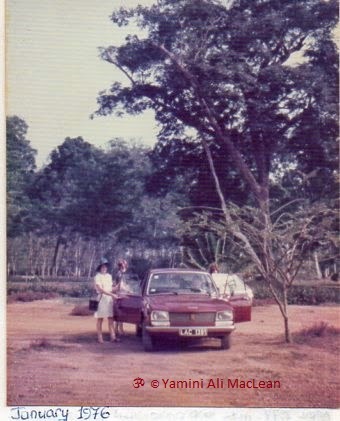
This photo was taken on the Okene road during Harmattan. There had been one of the many accidents which were inevitable given the conditions described above and it took a couple of hours plus every available hand, to shove the two trucks to the soft verges and get traffic moving again. Wherein lies the second part of Lesson 1; life is cheap. It applies in other lessons also. Attitude to life and death are significantly different. This is true of most of the African continent. Think Rwanda. It is worth mentioning, then, that another hazard of the roads, particularly if no other traffic around, was bandits. Do not stop where there are no witnesses. On one occasion of a lengthy trip back from the Auchi camp (the very same road you see above), the windscreen of the car was destroyed by a flying rock, kicked up by a passing truck. John the driver (a man of serious countenance, averse to deodorant and lax of style) kicked the remnants out with his right foot, having placed his left on the accelerator, losing not one kilometre of speed. As empty as the place looked, he was not willing to stop to do this maintenance because folk can just appear out of said emptiness and be carrying machetes and other such accoutrements, with less than good deeds in their minds. It was not a fun ride home. The rains were beginning and we went through several showers - so the wind plus our speed made needles of those droplets. It was freezing too. (My body became tense just writing all that. Cellular memory!!!) Anything other than trunk roads tended to be of very poor (if any) construction. During the rains of 1976, on a visit up to the mountains round Enugu (towards Cameroon in the area that was known as Biafra), we got bogged down more than once in knee-deep mud. Keynote of today's lesson? Nigerian travel - only if you have to.